
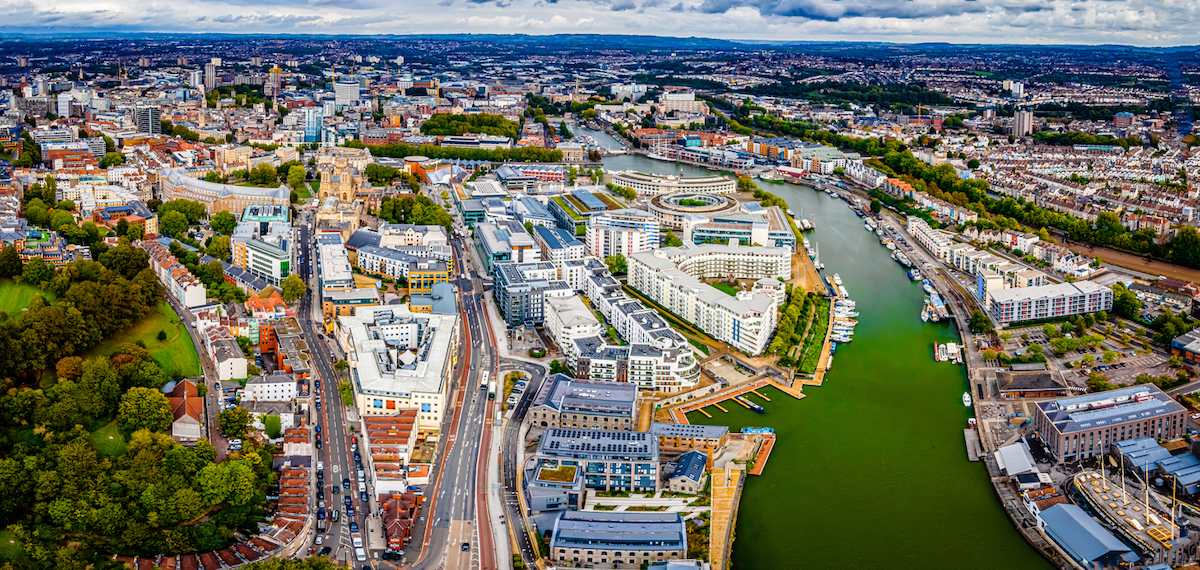
A community group in one of England’s most deprived areas has overcome strict planning laws to build a wind turbine that will power their entire housing estate and bring in £100k annually for community projects. How did they do it??
“Positive discouragement.” That’s how Andrew Garrad describes the UK government’s current onshore wind power policy – when he’s being diplomatic. “Pathetic” and “mealy-mouthed” when he’s not.
He should be aware: In April, the director Ambition Community Energy CIC received approval to build England’s largest wind turbine in the Lawrence Weston area of Bristol.
The project had been six years in the making – the process “long and arduous”, Garrad says – but the groundwork has now started for the 150m-high turbine which, once completed, will power around 3,000 homes.
“Onshore wind is the cheapest form of new generation, it’s zero-carbon,” says Garrad, “and yet we have a policy in England not to [build] it.”

UK planning laws have stopped the potential of onshore winds in the UK. Image: Sander Weeteling
That’s because in 2015, the UK government changed its default position on new onshore wind projects. Local planning authorities were directed to reject any new schemes unless they had community support and were located on a site designated for wind farms.
This decision effectively stopped the development and operation of onshore wind in the UK. So how did Ambition Community Energy overcome the odds – and can other communities follow suit?
Surviving the odds
The post-war housing estate of Lawrence Weston, where poorly-insulated homes and fuel poverty are serious issues, ranks among England’s most deprived areas.
Mark Pepper, the development manager at the local residents’ group Ambition Lawrence Weston, says the estate is: “an area you would stay for a little while until the housing department could re-house you.” Except, a lack of social housing meant that few people were being rehoused.
Pepper sought to make changes when the Conservative Party’s flagship austerity policy was introduced in 2010 and the local college shut down. He wanted to give Lawrence Weston residents reason to move there and re-empower the local community. Ambition Lawrence Weston was founded by him and other residents in 2012. It quickly became a success.
Onshore wind is the cheapest type of new generation.
It used £1m of National Lottery ‘Big Local’ funding to spend on the needs of residents: preventing the local youth centre from closing down and developing plans to build and open a new community health hub. Ambition also worked closely with housing developers in order to ensure that local families would receive the majority of new homes.
Their new wind turbine will produce equivalent energy to power the entire estate and bring in an estimated £100,000 a year or more for community projects. “This could be a gamechanger,” Pepper told the Guardian.
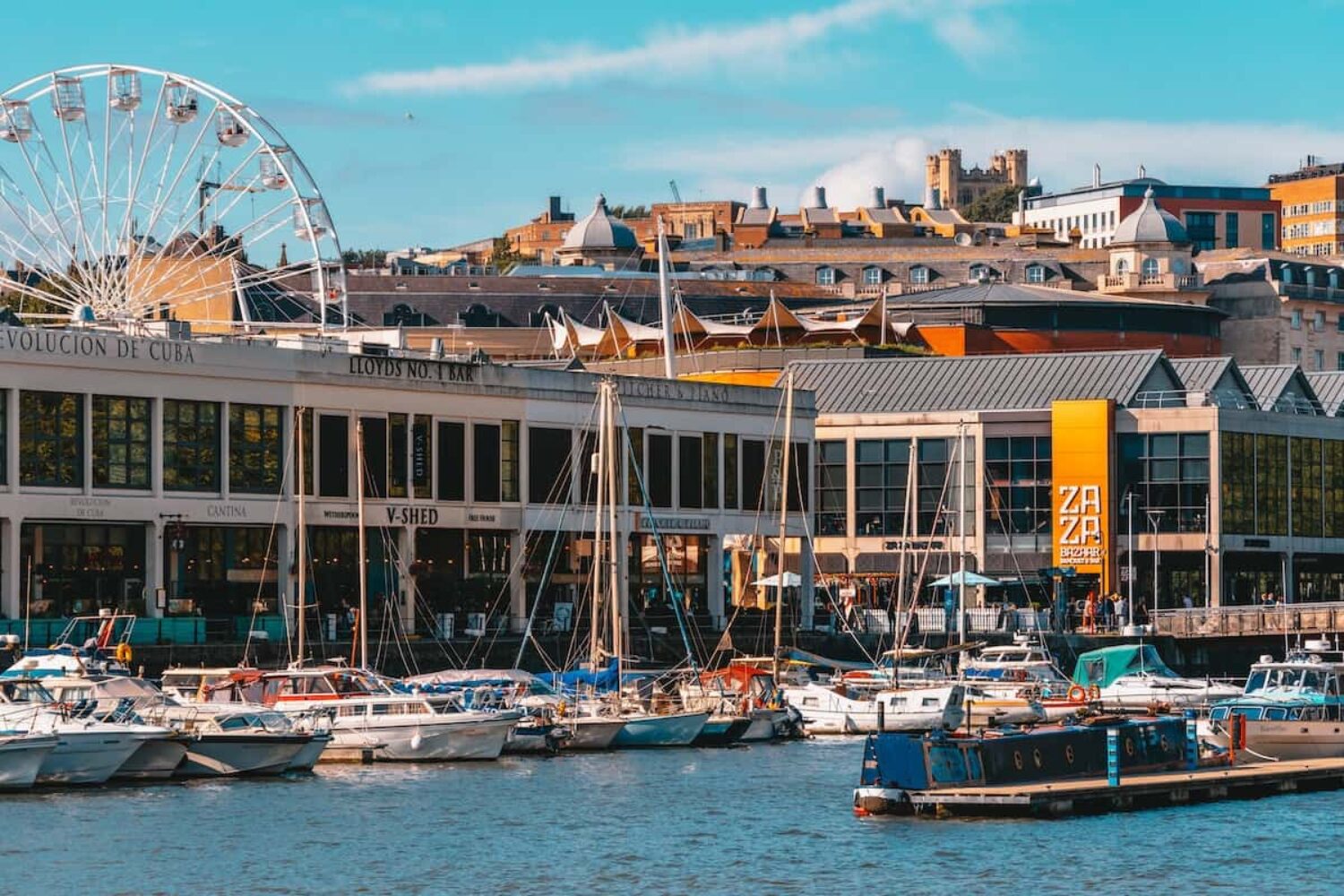
Back in 2015, Bristol was the UK’s first European Green Capital. Image by Martyna Roberter
Indeed, government research suggests that a community-owned wind energy model could retain “around 12 times greater economic value at a local level” than its commercial counterpart. There are still many obstacles to overcome.
“I don’t think that we have provided a blueprint for future community energy projects,” admits Andrew Garrad, who has worked in the wind energy sector since 1984. “But I think we’ve learned an awful lot of lessons which will be valuable to other community energy projects.”
Ambition Community Energy was required to raise the funds, build the project, and then find a way of selling the energy. “[Something] no other project would have had to do in the past,” says Garrad.
It is essential to get the support of your community. Wind energy is very binary
His advice to other groups interested in installing clean, locally-produced energy? “Getting the community on your side is vital. Wind energy is very binary. People either love it and see it as a symbol of clean power for the future or they see it as a blot on the landscape – and there’s very little in between.”
Recent government data suggest that 80 per cent of people in the UK now support onshore wind energyOnly 4 per cent opposed it. The Lawrence Weston project received 69 letters of support and one objection – from the owners of Seabank Power Station who were worried that the turbine could fall onto its cooling tower. Their fears were eventually allayed.
The group also had to make sure that the wind turbine could be connected to the grid. “It sounds very obvious but that’s quite a bureaucratic process and in many places, connection capacity has been used up,” says Garrad, which is something that could hamper future community projects.

According to the Met Office, Britain has the third highest average wind speeds in Europe. Image: Roonz NL
“Community groups should also realise that the process takes time, and tenacity – mainly to get planning permission. Mark and a few other people had been working tirelessly long before I arrived. It took six years to get to this stage”
The local planning authority officers initially recommended that the Lawrence Weston scheme be rejected. However, the Bristol city council planning board voted unanimously for it. It was then sent for final approval to Robert Jenrick MP the secretary of state responsible for housing, communities, and local government.
Garrad and others believe this will change quickly. Bristol city council declared a climate emergency in 2018 and the government has plans to decarbonise the UK’s electricity system by 2035. It says it will “double down on efforts to deploy a new generation of home-grown technologies,” despite there being no relaxation of the planning rules around onshore wind in the recently published energy security strategy. However, the document did not include a small nod for communities that wish to host such projects. “[We] will consult this year on developing local partnerships,” the strategy said.
Onshore wind will be vital to the UK’s low-carbon mix as it’s one of the quickest renewable energy sources to set up. A typical project takes one year plus planning, while a new nuclear plant can take up 20 years.
“Onshore renewables in the UK are an obvious choice from an economic and environmental perspective,” says Matthew Clayton, managing director at Thrive Renewables, who provided Ambition Community Energy with a £4m loanto finance the construction of the turbine. “[But] it’s currently a challenging choice from a political perspective.”
In June, a progress reportThe independent Climate Change Committee concluded that the UK is likely to miss its legal targets of reducing greenhouse gas emissions to net zero by 2020.
“The country is begging for an end to its dependence on fossil fuels,” said the chairman, Lord Deben. “The window to deliver real progress is short.”
The country is crying out to end its dependence on expensive fossil fuels
According to the Met Office, Britain has the third highest average wind speed in Europe, after the North and Baltic Seas. This means that offshore wind power can be generated here at half the cost as nuclear power and only 25% less than gas.
For those who want to replicate what is happening in Bristol, Clayton says: “There are numerous organisations which can support motivated people and motivated communities with their thinking. Community Energy England is a great place to start.”
For feasibility and early-stage planning, there is also funding from the government. “So if you’re got a plan and a vision, then I really encourage people to treat it as the art of the possible rather than the impossible,” says Clayton.
Maybe the winds are changing.
Main image: Alexey Fedoren/iStock

