
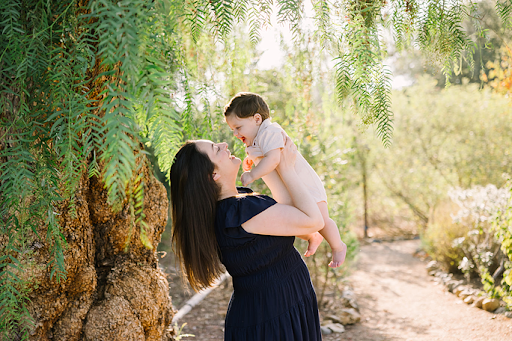
For Rachel Klein, motherhood did not arrive as a simple milestone. It arrived as a transformation. It altered the way she experiences love, vulnerability, exhaustion, and joy. More than any other chapter of her life, it has reshaped how she sees herself and the world around her.
She describes motherhood as creating life and nurturing it beyond the limits of her own perceived ability. It is not merely a responsibility to her; it is a calling that stretches her in ways she did not anticipate. It demands more patience, more softness, and more resilience than she thought she possessed. Yet within that demand, she has discovered a depth of fulfillment that surpasses anything she has known before.
Motherhood, she says, means more to her than anything else ever has.
Living in the Beauty and Exhaustion of the Present
Rachel’s current season of motherhood is both physically demanding and emotionally expansive. Her days are filled with motion—small footsteps navigating newly discovered freedom, tiny hands reaching for reassurance, and moments of affection that catch her off guard with their intensity. Watching her child experience the world with curiosity and wonder has redefined how she understands joy.
There is exhaustion woven into the fabric of her days. The kind that settles into the body after nights of interrupted sleep and the constant vigilance required to care for a young child. Yet alongside that fatigue exists something equally powerful: delight. She finds herself melting at small gestures of affection, overwhelmed by how much love can exist in such a small human.
One of the most striking aspects of this stage is witnessing her child’s growing independence. The simple act of walking—of choosing direction and movement—has become a symbol of freedom. Rachel sees in those early steps both the beauty of growth and the inevitability of change. Each milestone is a reminder that this season, however consuming, is temporary.
Rather than rushing through it, she is trying to remain present within it.
Discovering the Power of Intuition
Before becoming a mother, Rachel did not always trust her instincts. Like many women, she questioned her decisions, second-guessed her reactions, and looked outward for reassurance. Motherhood has changed that. It has revealed to her that intuition is not a weakness or a guess; it is a form of knowledge shaped by love and attention.
She describes motherhood as an art form. There is no fixed formula, no guaranteed method that ensures success. Instead, it requires attentiveness, adaptability, and emotional awareness. For the first time, she feels like an artist—someone learning through practice, refining through experience, and trusting her own creative instincts to guide her.
This shift has been empowering. It has allowed her to move through uncertainty with greater confidence, even when challenges feel overwhelming. She understands now that there is no universal template for motherhood. There is only the relationship between a mother and her child, and the quiet decisions made daily within that bond.
Trusting herself has become one of the most valuable lessons she has learned.
The Loneliness That Few Talk About
Rachel is honest about the complexity of her journey. While she feels grateful for a loving and supportive husband and a village of family and friends who have helped carry her through, she acknowledges that motherhood has still felt deeply personal and, at times, profoundly lonely.
There is a solitude that exists even within support systems. The emotional labor of motherhood cannot always be shared. The mental calculations, the constant awareness, and the quiet self-reflection happen internally. Rachel has sometimes felt that her experience has been more difficult than it appears to be for others, and that comparison has brought its own challenges.
Yet she has come to understand that motherhood is inherently individual. No two journeys are identical, and no external perception can fully capture what happens behind closed doors. Recognizing this has helped her extend grace to herself.
She no longer measures her experience against someone else’s highlight reel. She accepts that her path is her own.
Learning to Love Herself Alongside Her Child
If Rachel could offer one message to other mothers, it would center on forgiveness. She believes that babies love their mothers unconditionally, long before mothers feel they have earned it. That realization carries both comfort and responsibility.
She encourages mothers to forgive themselves for mistakes and to love themselves intentionally. The way a mother treats herself, she believes, sets the tone for how she loves her child. Self-compassion is not indulgent; it is foundational.
Motherhood has taught Rachel that growth is continuous. There will be missteps and moments of doubt, but those do not negate the love that anchors everything else. What matters most is the willingness to return to grace, again and again.
Embracing the Journey in Its Entirety
Rachel does not romanticize motherhood as purely blissful. She acknowledges its difficulty, its emotional intensity, and its capacity to stretch a person to their limits. At the same time, she recognizes it as the most beautiful experience of her life.
The exhaustion and the joy coexist. The loneliness and the gratitude live side by side. The vulnerability and the strength emerge together.
She counts her blessings daily—not because the journey is easy, but because it is meaningful. She is thankful for her partner’s steady presence and for the community that supports her family. Most of all, she is thankful for the opportunity to participate in this deeply personal transformation.
Motherhood, for Rachel, is not simply about raising a child. It is about becoming someone new in the process.
It is about learning to trust herself, to forgive herself, and to love with a depth that defies explanation.
And in embracing all of it—the beauty, the difficulty, the solitude, and the joy—she has found that motherhood is not something to master.
It is something to live.
Published on Faith Family America

