
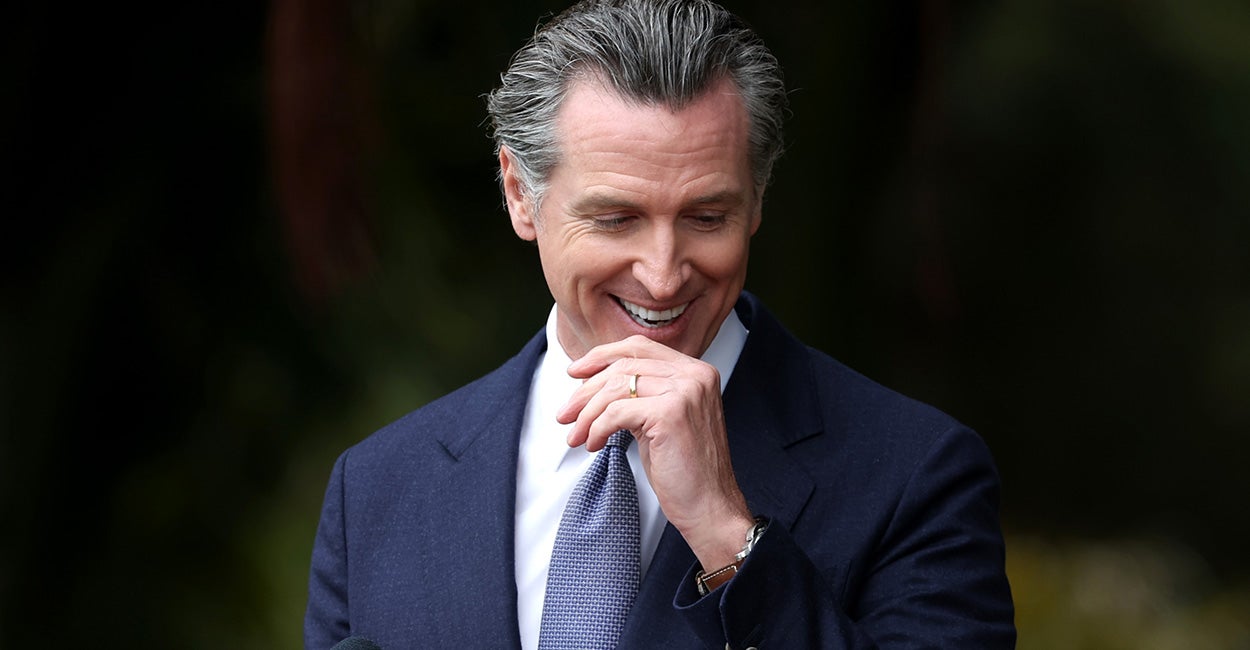
California Gov. Gavin Newsom appeared caught off guard by a backlash against his vacation this week in Montana, one of 22 states subject to California’s ban on official travel based on those states’ “discriminatory laws” against the LGBTQ community.
Newsom’s communications team quickly revved into gear after reports that the governor was spending his downtime in the Big Sky State, telling a number of reporters that the California prohibition only applies to state-paid travel, and this was a private family affair not subject to the ban.
By that time, though, the Democratic governor’s Montana holiday was already a viral Twitter flashpoint, with Republicans lampooning the move as an optics disaster that further cements Newsom’s reputation as an elitist politician with a double-standard problem.
“Does Montana have a French Laundry,” Jon Levine, a politics and culture reporter for the conservative New York Post, asked while needling the governor on Twitter. Levine was referring to another low moment in Newsom’s gubernatorial tenure when he was photographed eating out at the Michelin-rated three-star French Laundry restaurant after advising against social gatherings during the pandemic.
It didn’t help that Newsom launched a July 4-themed attack ad just days earlier against the red state of Florida and Gov. Ron DeSantis (a top GOP 2024 presidential hopeful), has fueled speculation about his White House ambitions.
For many conservatives, Newsom’s choice to spend his off hours in a red state that Donald Trump won by 16.4 percentage points in 2020 was easy fodder for ridicule. But the social media tempest the trip stirred is also drawing new scrutiny to California’s and other states’ rules designed to punish states that pass laws California and other liberal bastions deem harmful to the LGBTQ community.
Six states and the District of Colombia have for the last six years banned their employees’ travel to states that, in their opinion, discriminate against gay, bisexual, lesbian and transgender persons. California’s prohibition is by far the most sweeping, barring state-funded travel to nearly half the country: 22 states, including four additions–Arizona, Indiana, Louisiana, and Utah–last week.
California, Connecticut, Minnesota, New York, Vermont, Washington, and the District of Columbia all have sought to financially pressure several other states in some form or another–creating a confusing patchwork of bans, with some states lifting previous travel bans on other states, such as Indiana, that revise laws applying to the LGBTQ community after a national or statewide uproar.
This government-to-government retribution is reminiscent of the “cancel culture” that led Major League Baseball to move the All-Star game from Atlanta to Denver in 2021, after Democrats retaliated against Georgia over new election laws passed by the state’s Republican legislature. However, the bans on state-funded travel have been in place for a long time. Boycotts have been a revered tactic of labor groups, human rights activists, for nearly 150 years. They have been used against entities that range from British slumlords living in Ireland in 1880s to Rhodesia’s entire country in 1965. This boycott eventually led to the fall of its racist regime. Boycotts against discriminatory businesses against blacks were a key component of civil rights movements in the 1950s, 1960s.
The first gay rights-themed boycott predated Florida’s “Don’t Say Gay” law by some 45 years, but it also took place in Florida. Anita Bryant, an evangelical pop star and socially conservative Christian, was the spokesperson of the Florida Citrus Commission. Bryant was also a vocal political activist who helped to organize anti-discrimination codes across a range of cities, including Miami and Eugene, Oregon. In response, gay and laic organizations boycotted Florida orange juice.
In so doing, a new element had been added to boycotts–targeting not just an industry, but a state as well. In 1987, Arizona Gov. Evan Meacham rescinded a Martin Luther King holiday, even though President Reagan had signed legislation in 1983 making King’s birthday a federal holiday. After the issue was put to a state referendum in 1990–and it was defeated–the numerous conventions scheduled in Arizona were canceled in response, and the National Football League announced it was moving the 1993 Super Bowl out of Phoenix.
Two decades later, Arizona was in liberal crosshairs again, this time for a statute aimed at curbing illegal immigration–and which critics immediately derided as discriminatory. Conferences were again targeted, and this time not just by private organizations. Los Angeles banned state travel to its eastern neighbor and other governmental entities followed. By the time Arizona’s notorious “show me your papers” law was vacated, the strategy of states boycotting other states had crystalized, mainly because it seemed to work. According to the liberal Center for American Progress, the Arizona boycott had cost the local economy tens or millions of dollars in lost revenues.
New York and other states enacted bans on state funding of travel in 2015 to take aim at Indiana and its former governor. Mike Pence for enacting the “Religious Freedom Restoration Act.” The law allowed Indiana businesses to refuse to serve same-sex couples and other members of the LGBTQ community based on religious grounds.
It was in place for only one week before Pence, who had been under pressure to significantly revise the law after a national scandal and boycott by many corporations, gave in to his demands. Indianapolis-based Angie’s List (now known as Angi) announced a hold on a $40 million expansion that would bring 1,000 new jobs to the state, and the CEO of Salesforce, a $4 billion software giant, revoked a deal expanding its presence there. GenCon LLC, a major gaming conference that meets annually in Indianapolis threatened to withdraw. NCAA President Mark Emmert expressed concern about hosting Final Four games within the Hoosier State.
Washington, New York, Connecticut and New York quickly imposed bans on state-funded travel from Indiana. They were lifted after Pence signed a revised law that they considered more acceptable.
By that time, however, the controversy over Pence’s Religious Freedom Restoration law had cost Indianapolis nearly at least a dozen conventions with estimated revenue near $60 million.
“In the case of Indiana, the state [ban] pressure was equally as squeezing as the corporate muscle we felt flexing,” Chris Gahl of Visit Indy, the city’s convention and visitors bureau, told Stateline.org, a publication funded by Pew Charitable Trusts, in 2017. “In all 12 cases, it was fear that if they had booked Indianapolis, they were unsure if they could drive delegate attendance based on the perception that Indy was no longer welcoming … It’s not superficial–it has a real impact.”
After witnessing the impact of Indianapolis, several mayors of liberal urbanities, including New York City, San Francisco, Seattle and Minneapolis, took action. They announced bans for city-funded travel to North Carolina, amid a national backlash against House Bill 2. This law prevented transgender individuals in North Carolina from using bathrooms that are compatible with their gender identity. North Carolina legislators quickly found a compromise that allowed collegiate sporting events to return the state. However, some big-city mayors still prohibited employees from traveling to North Carolina.
Bruce Springsteen, a rock star, cancelled a concert at Greensboro, North Carolina. More than 130 chief executives of corporations signed letters to the governor of North Carolina. Pat McCrory urged that the law be repealed. Bank of America, whose headquarters are in Charlotte signed on. An Associated Press analysis of the situation at the time found that HB2 would result in more than $3.76 Billion in lost business over a period of 12 years.
Then-New York Governor. Andrew Cuomo passed a ban on unnecessary government trips to Tar Heel State. After Mississippi passed a law that allowed religious groups and businesses to refuse service to LGBTQ couples and individuals, Cuomo extended the ban to Mississippi a week later. New York, Vermont, Washington State and the District of Columbia followed suit quickly.
The former governor of California, Jerry Brown, joined the effort just a few months later in the fall 2016. Jerry Brown, Newsom’s predecessor, joined the effort, signing a law severely limiting state-funded travel to North Carolina and any state “supporting or financing discrimination against lesbian, gay, bisexual and transgender people.”
Xavier Becerra (then-California AttorneyGeneral) greatly expanded the list over two years. He added Alabama and Mississippi, Kansas, Mississippi. Kentucky, South Dakota. Tennessee, and Texas. Becerra had a reason why every state was restricted, he explained. Iowa was, for instance, blacklisted for preventing the use of Medicaid funds to pay for certain transgender surgery procedures.
California’s law originally included a few exemptions for some trips, such as travel needed to enforce California law and contracts made before 2017. The number of exemptions has been greatly increased since then.
There were concerns that the law could harm college athletics at California universities. It would prohibit scouts and recruiters from high schools in California affected by the travel ban. Since then, waivers were issued by the state to allow athletes and other participants to attend events that are on the banned list.
Red states rarely offer retribution or reciprocity. California and other states that enact laws are happy to host government officials from outside their borders for lucrative conferences or events. At least one state targeted has attempted to strike back, though in a limited fashion. In 2018, Tennessee’s Senate and House speakers barred any state funds from going to lawmakers’ attendance at the National Conference of State Legislatures convention in San Diego that summer.
Tennessee’s top two leaders in the legislature at the time, Senate Speaker Randy McNally (who is now lieutenant governor) and House Speaker Beth Harwell, wrote a letter to NCSL executives laying out their reasoning.
“This is not an action we feel any pleasure taking,” they wrote. “It is California, not Tennessee [that]This started the chain of events. The pair noted that “the moment California rescinds its ban, Tennessee will begin approving travel to California. We hope that moment comes soon.”
Not surprisingly, it didn’t. California added 12 states to the ban over a law banning transgender women or girls from participating school sports. (San Francisco’s city council has gone even further, prohibiting the city from doing business not just with states it finds wanting, but companies from those states.) Does this tactic have diminishing returns? Some believe so. contracting process in San Francisco has not only become cumbersome, but also added costs that must be borne by taxpayers.
At the statewide level, California hasn’t hesitated to expand its travel bans to punish purple states for passing legislation the LGBTQ community strongly opposes. Arizona, a swing state, was placed on the blacklist after it fell to Biden by a narrow margin of nearly 10,500 votes. Bonta said Arizona’s GOP lawmakers earned the rebuke for recently enacting laws prohibiting healthcare professionals from providing, and insurance companies from covering, “gender-affirming care for minors.” He also cited a law barring transgender women and girls from participating in intramural and interscholastic school sports. Indiana, Louisiana, and Utah were added at the same time for their laws against transgender women and girls competing in women’s sports leagues.
California is the only state with such strict travel bans. Newsom is now discovering how frustrating they can be when planning vacations. His in-laws own Montana ranch, where he and his wife were married in 2008. Supporters argue that avoiding visits to the state where his wife’s parents live is an overly onerous expectation.
“We are not in the business of regulating where people have family or where they spend their vacation,” Newsom spokeswoman Erin Mellon told RealClearPolitics. “Nor will we persecute them for visiting their family. The press shouldn’t either.”
Mellon refused to comment on whether Newsom and his family were accompanied by state staffers from California, including a security detail. This could be a violation of the prohibition against state-funded travel.
Ronald Kessler (author of many books on the FBI/CIA) stated that governors typically have security detail consisting of at most five state troopers at a moment, which could translate into a total number of twelve or more for round the clock protection. Kessler also notes that Montana law enforcement resources are likely contributing to Newsom’s and his family’s protection while they’re in the state.
Gary Byrne (a 29-year veteran of law and order, including the Secret Service), said that Newsom could be accompanied by one California state trooper or police officer if he tried to keep his family’s visit under the radar.
“They’ll usually coordinate with local law enforcement of whatever town they’re going into and in this case also with the Montana state police,” said Byrne, author of “Secrets of the Secret Service” and “Crisis of Character” about his experiences protecting President Clinton.
While the extra protection would amount to an expense for Montana law enforcement, a potential violation of the Golden State’s travel ban would only occur if aides in Newsom’s office or California state police accompanied him. Newsom’s office would not say whether staffers and police escorted the Newsom family on vacation, nor whether the governor would personally have to reimburse the California treasury for state resources expended for the travel.
A provision in the California travel law, AB 1887 could help protect the governor from security detail costs. It provides an exemption to the travel ban for “the protection of public health, welfare, or safety, as determined by the affected agency, department, board, authority or commission, or by the affected legislative office.”
Bonta’s office responded to questions about the legality of Newsom bringing staff or security to Montana by referring RCP to Newsom’s office. “It’s ultimately up to each California agency to make determinations about the steps they’ll need to take to comply with [the law],” Bonta’s press office said in a statement.
Newsom’s spokeswoman was tight-lipped. “We do not comment on the governor’s detail due to security concerns nor am I going to give specifics about where he is staying due to security risks,” she said.
Originally published by RealClear Politics RealClearWire distributed the information.
Are you a fan of this article? To sound off, please email letters@DailySignal.com and we’ll consider publishing your edited remarks in our regular “We Hear You” feature. Be sure to include the article’s URL, headline, and your name.

