
When a child announces what they will be when they grow up, they are almost never describing a job. They are describing an image: the coat, the animals, the truck, the uniform. The work itself has not entered the picture, because nothing has shown it to them.
Elizabeth Tweedale, founder of the online coding school Coco Coders, watched this happen with her own daughter, who declared at five that she would be a veterinarian.
“She realized you actually have to deal with really sick pets,” Tweedale said. “The dream dissolved because the reality was sad, not just cuddly.”
Nothing went wrong there. A child tested an image against reality and updated. The problem is what happens when no test arrives, and the image quietly hardens into a plan.
Why the early years matter more than the careers evening
Research published by the OECD in 2020 found that the career aspirations of seven-year-olds already carry the marks of gender stereotypes and social background, and that these barely shift by seventeen. The formal careers conversation, when it finally happens, is arriving after the shortlist has been written.
The 2018 Education and Employers study Drawing the Future asked over 20,000 primary school children to draw the job they wanted. Fewer than one percent had heard about it from someone who visited their school. Television, social media and family accounted for nearly all of it.
That is a very small window onto a very large economy, and it is not a random sample. Children see the jobs that are visible, which is not the same as the jobs that exist.
Four things that widen the window
Name the invisible parts of a familiar job. A vet practice runs on scheduling software, diagnostic imaging, supply logistics and a website somebody maintains. Saying so out loud converts one job into five.
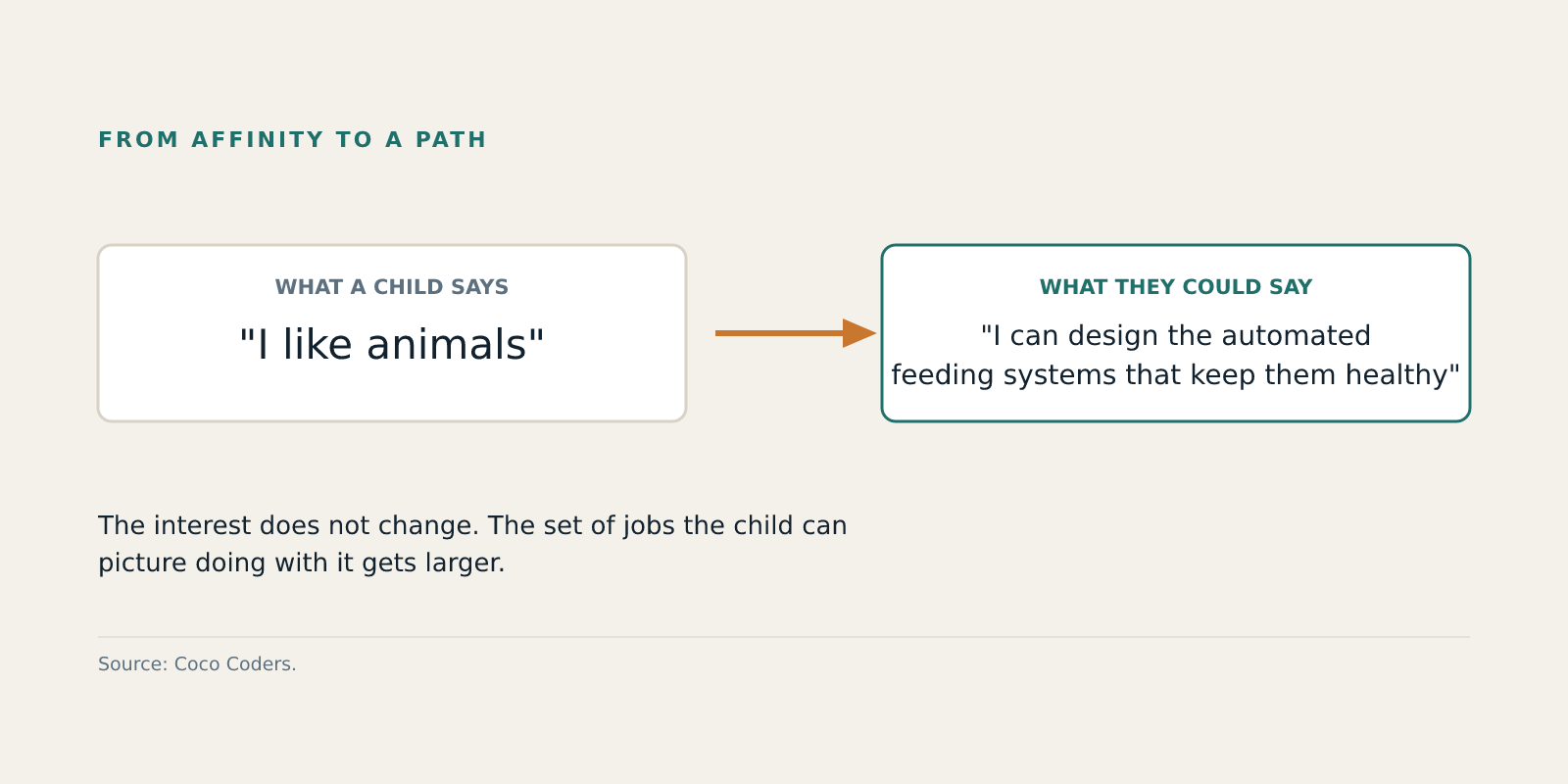
Follow the interest, not the job title. A child who likes animals may be a better fit for designing the systems a shelter network runs on than for clinical work. The affinity is the durable part; the job title is the guess.
Introduce real people doing real work. This is the intervention with the strongest evidence behind it, and the one Education and Employers found is almost entirely missing.
Let the image break. A dissolved dream at six is information. A dissolved dream at twenty-two, three years into a degree, is expensive.
What good early exposure looks like
Coco Coders structures its programmes around real systems rather than abstractions. Ten-week foundation blocks are followed by four-week deep dives on an existing piece of technology. Studying ocean plastic, students look at Mr. Trash Wheel, the solar-powered device that pulls debris out of Baltimore’s Inner Harbor, and then build a game or simulation of their own around the same problem.
“It’s saying, here was a problem, here was the solution. Now, what’s your idea?” she said.
The code matters less than the position change. The student stops watching a problem and stands inside it holding tools.
Questions parents ask
Is it too early to talk about careers with a six-year-old?
The OECD’s 2020 findings suggest the opposite risk. Aspirations formed at seven persist to seventeen, so the early conversation is the one doing most of the work.
Should I push a child toward technology if they show no interest?
Interest in technology is not the goal. Understanding that technology sits behind whatever they do care about is, and that can be reached through art, animals, sport or cities.
What if my child changes their mind constantly?
That is exploration working as intended. The concern is the child who never changes their mind because they have only ever seen one option.
Does my child need to be good at maths to start coding?
Coco Coders states that its classes require no prior experience and are designed for all levels, including neurodiverse learners. Its curriculum is set out at cococoders.com.
About Coco Coders
Coco Coders is an online coding school founded in 2016 by Elizabeth Tweedale. It teaches Scratch, Python, HTML, CSS and JavaScript to school-age children through live interactive classes in group and private formats, and works with students in the United States, the United Kingdom and internationally. Course information is published at cococoders.com.

