
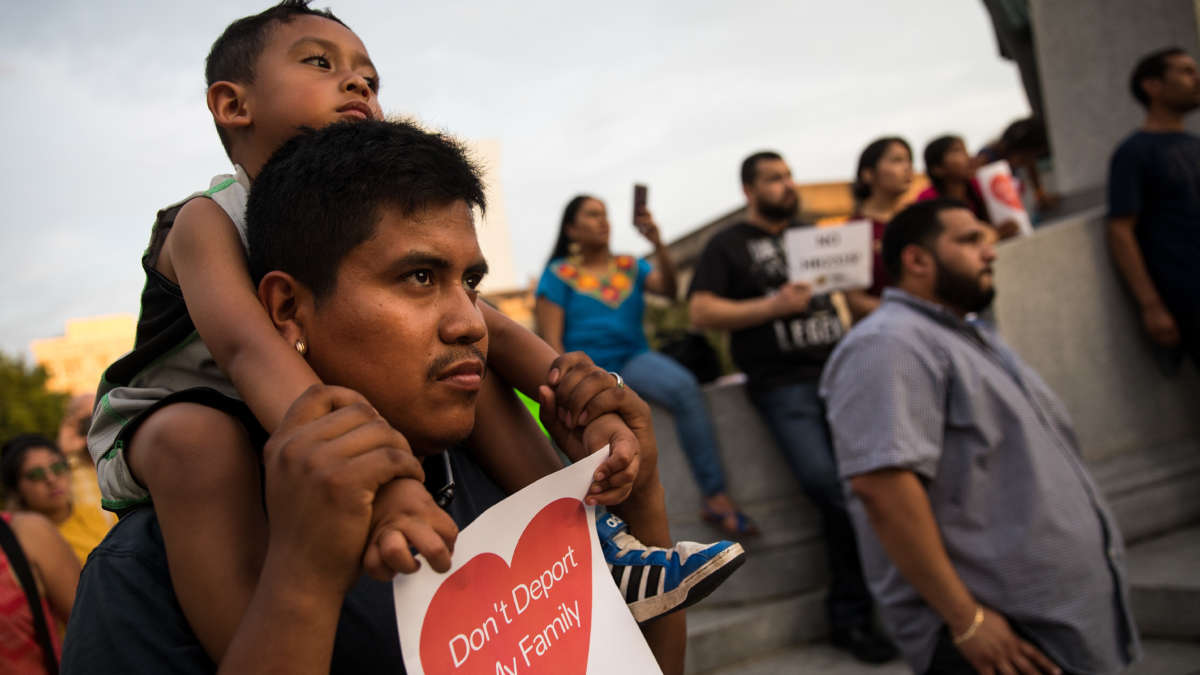

The 6th Circuit Federal Appeals Court ruled on July 5 That the Biden administration could enforce guidelines to pause deportations unless individuals had committed acts of terrorism, espionage, or “egregious threats to public safety” in a lawsuit brought on by Arizona, Ohio, and Montana. The conservative sister court of the 5th Circuit was notified the next day. issued a ruling In a similar suit brought by Texas and Louisiana, the Biden administration was prevented from enforcing these new guidelines.
These conflicting rulings will now be sent to the Supreme Court by the Department of Homeland Security guidance for an ultimate decision. This will leave the fate of deportation determinations up to a notoriously conservative court. two decisions last month These rights are not available to all immigrants. The Court unexpectedly decided While Biden will be able to end Trump-era Remain Mexico policy, it remains to be seen what the Supreme Court will do regarding deportations. In the interim, the fate of immigrants attempting to migrate to the country will be in the hands of local Immigration and Customs Enforcement officers’ own determinations. Nayna Gupta, Associate Policy Director at the National Immigrant Justice Center, stated that the inconsistent circuit court rulings can cause confusion which can be particularly harmful for immigrants who find their way into this precarious limbo.
“It goes without saying that this is not a friendly court for immigrant communities,” Gupta said. “We’ve seen a couple of really problematic decisions. We also recently witnessed a positive decision regarding Remain in Mexico. So, I can’t make predictions.”
Deportation priorities have been the subject in back-and forth litigation. There has not been a clear direction for ICE officers as to who they should be detaining, arresting, or pursuing proceedings against. Gupta says that this will mean that there will be many ways in which decisions are made.
“It’s not entirely clear, to be honest, to us as advocates what ICE officers might be following right now,” Gupta said. “What fills in is not really clear, it doesn’t mean they automatically revert to an old set of priorities. There’s really just … no clear answer.
While former President Donald Trump’s policy was to deport immigrants regardless of criminal history, Gupta said ICE officers should not immediately revert back to implementing a previous guideline. Gupta stated that it is possible that there won’t be any immediate changes due to the Department of Homeland Security determining the best next steps.
“We don’t necessarily have a clear sense of what’s going to happen on the ground,” Gupta said. “But we’re certainly worried and concerned that this lack of clarity could be really harmful for our communities. It would mean individual ICE officers having even more discretion than ever before in deciding whom to pursue immigration laws against.”
The heart of the legal dispute is a question about the Biden administration’s ability to decide the priorities for how it enforces U.S. immigration laws. States also have the right to sue against these priorities. In the current political landscape where conservative courts are siding with states’ rights, this could be another push in that direction.
The Department of Homeland Security and Secretary Alejandro Mayorkas have not released a statement or clarification regarding the rulings, and they have not returned Prism’s request for a statement. Gupta said that communities with higher anti-immigrant sentiments among local law enforcement agencies are at risk.
“It’s a mess, really. There’s confusion,” Gupta said. “Communities could be at higher risk now because ICE officers have been left to their own devices to make decisions.”
Gupta would like to see DHS issue a statement, or guidance, on what will happen next on the enforcement front. She also hopes that enforcement priorities will be delayed so advocates can prepare for what lies ahead.
“We don’t want to see enforcement actions against our communities,” Gupta said. “If you’re unable to enforce civil immigration laws in a clear, transparent, consistent manner, there should be a pause on aggressively enforcing them. Rather than an uptick in enforcement actions, there should be a slowing of them because of this confusion.”
PrismThe newsroom is non-profit and independent, and is led by journalists of colour. We report from the ground and at the intersections with injustice.

