
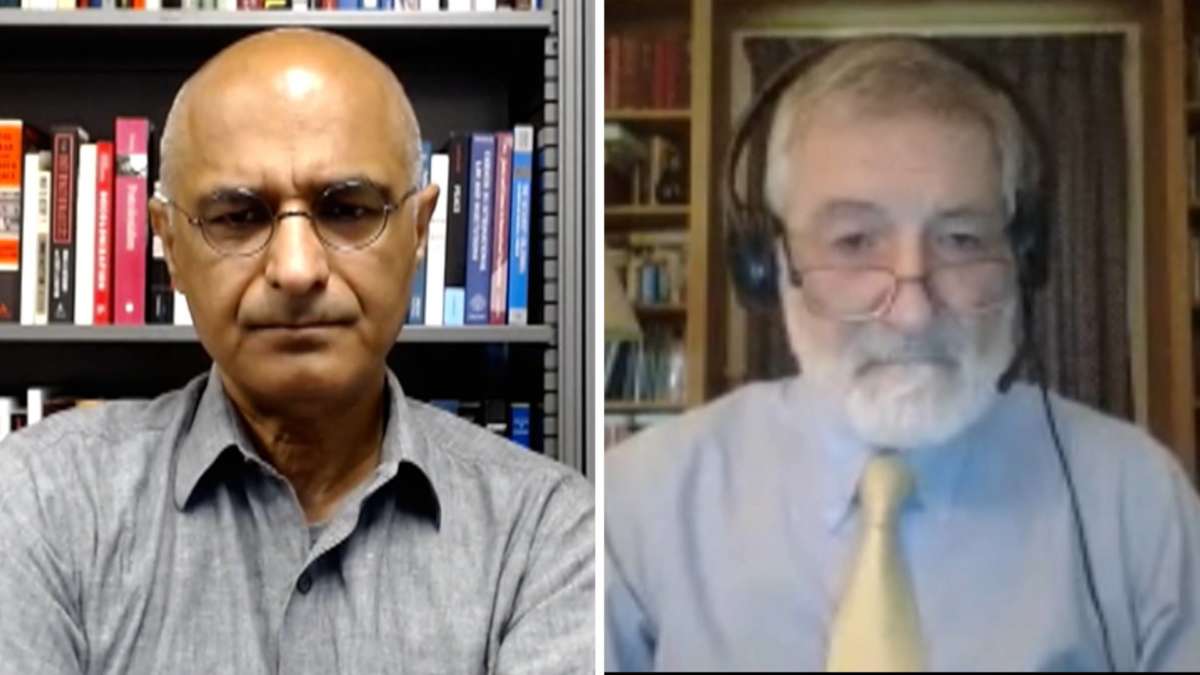
The U.N. warned this week that humanity is “one miscalculation away from nuclear annihilation” as tensions escalate globally. We speak with Ira Helfand, former president of the International Physicians for the Prevention of Nuclear War, who says the U.N. Security Council permanent members, comprising Russia, China, the U.S., the U.K. and France, are pursuing nuclear policies that are “going to lead to the end of the world that we know.” We also speak with disarmament activist Zia Mian, co-director of Princeton’s Program on Science and Global Security, who says non-nuclear weapon states must pressure other countries to sign onto the 2017 Treaty on the Prohibition of Nuclear Weapons.
TRANSCRIPT
This is a rush transcript. Copy may not be in its final form.
AMY GOODMAN:This is Democracy Now!, democracynow.org, The War and Peace Report. I’m Amy Goodman, with Nermeen Shaikh.
The United Nations Secretary-General António Guterres warned this week humanity is, quote, “one miscalculation away from nuclear annihilation.” He made the comments at the opening of a major U.N. gathering here in New York to review the Nuclear Non-Proliferation Treaty. The meeting comes at an era when tensions are increasing between the United States of America and Russia and China. This is part of António Guterres’s remarks.
SECRETARY–GENERAL ANTÓNIO GUTERRES:The clouds that parted after the end of Cold War are gathering again. We have been extraordinarily fortunate thus far. Luck is not a strategy. Nor is it a way to protect yourself from geopolitical tensions that escalate into nuclear conflict. Humanity is only one mistake or misunderstanding away from nuclear destruction. We need a treaty to prevent the proliferation of nuclear weapons. This is why the review conference is so crucial. It’s an opportunity to hammer out the measures that will help avoid certain disaster and to put humanity on a new path towards a world free of nuclear weapons.
AMY GOODMAN:During his speech the U.N. Secretary-General also announced plans to visit Hiroshima (Japan) this week. Seventy-seven years ago, on August 6, 1945, the United States dropped the world’s first atomic bomb on the Japanese city, killing an estimated 140,000 people. [Three] days later, the United States dropped another atomic bomb on Nagasaki — it was August 9th, 1945 — where at least 74,000 people died.
To talk more about the threat of nuclear war, we’re joined by two guests. Zia Mian, physicist and disarmament activist, is here with us. Zia is co-director of Princeton University’s Program on Science and Global Security, and co-author. Unmaking the Bomb: A fissile material approach to nuclear disarmament and nonproliferation. Dr. Ira Helfand, the immediate past president of the International Physicians for the Prevention of Nuclear War, was also present. He was also cofounder and past president of Physicians for Social Responsibility. His new pieceIn The Hill is headlined “Are Russia and NATOTry to destroy the NPT?”
Dr. Ira Helfand, explain.
DR. IRA HELFAND:There have been numerous threats from Russia, some of which are listed below. NATOTo use nuclear weapons within the context of the war on Ukraine. This is a completely unacceptable situation. In response, my organization, the IPPNWTogether with 17 other Nobel Peace laureates, he organized a statement demanding that Russia and NATOThey have made a clear promise not to use nuclear weapons in any circumstance. They’ve refused to do that.
Now they’re coming into the NPT meeting demanding, as they always do, that the countries which don’t have nuclear weapons continue to refrain from obtaining them, while they themselves will not even promise not to blow up the world this week. And it’s an extraordinarily hypocritical situation. It is this kind of behavior that has led to the NPTAt risk
The great powers attempt to blame the Treaty On the Prohibition of Nuclear Weapons. They try to identify that as a source of risk to the Non-Proliferation Treaty, because 121 countries around the world have come together and said that they will not — they will honor their obligations under the NPTNot to develop nuclear weapons. The real threat to the NPT comes from the five permanent members of the Security Council — the NATO members, the United States, the U.K. and France; Russia and China — who are obliged under the NPTto enter into good-faith talks to eliminate their nuclear arsenals. This is something that they have repeatedly refused to do for over 50 years.
And that’s the problem that we’re facing. And the behavior NATORussia’s involvement in the Ukraine conflict has highlighted the total failure of permanent members of Security Council to uphold their end of the Non-Proliferation Treaty bargain. And I think that’s what puts the treaty at risk.
NERMEEN SHAIKH: Dr. Zia Mian, could you comment on your concerns about what’s going on at the Zaporizhzhia nuclear plant, which is, of course, the largest in Europe and one of the largest in the world?
ZIA MIAN: The Zaporizhzhia nuclear plant — I mean, as Shaun Burnie mentioned in your earlier segment, and as Ira also observed, nuclear plants were never designed, intended or imagined to be in war zones. They are dangerous enough even in peace time, given the history of nuclear accidents, complex technologies, institutional and human failures that we’ve seen throughout the history of all complex technologies. But what we’ve seen for more than 40 years now are attacks on nuclear power plants.
It’s worth remembering, 40 years ago, Israel attacked a nuclear reactor in Iraq, and that was the first attack on a nuclear reactor by another state. Reactors were also attacked during the Iran-Iraq War. The reactor at Dimona, Israel, was also attacked. Cyberattacks are now also targeting nuclear reactors.
So we need to ask ourselves if we can feel safe in a world in which these extremely dangerous technologies coexist in a system that cannot manage even ordinary technologies, let alone technologies with catastrophic failures, and in which states go to war on other types of industrial facilities, including nuclear reactors, and not just cities and individuals.
And so, one of the things to keep in mind is that India and Pakistan long have lived with the threat of attacks on each other’s nuclear facilities. And in 1988, they actually agreed a treaty between them to not attack each other’s nuclear facilities, because of fears of the consequences of such attacks. And this may be the kind of thing that other states should also pick up on and ask the question — until we can shut down all nuclear facilities safely and make sure that these problems can’t recur in the future, at least we should have agreement not to attack them.
NERMEEN SHAIKH:Zia, you and your colleagues from Princeton worked together earlier this year to simulate what might happen in an escalation of a conventional war between America and Russia. This simulation looked at how a nuclear war could become. Could you speak about the simulation and what you discovered?
ZIA MIAN:The Princeton Program on Science and Global Security began to explore how to understand the effects of the U.S.’s current situation many years ago. NATOWe were able to understand the Russian nuclear war plans. After analyzing the war plans, as well as what we know about the locations and number of U.S. nuclear weapons, their positions, and their targets, we tried to imagine what would happen in a conventional conflict. This would involve one side using nuclear weapons on the battlefield, followed by retaliation, then escalation to the second stage, which would see both sides use more nuclear weapons and then all-out nuclear warfare.
It found that in just a few hours there would be more than 100 million casualties. And the U.S. Strategic Command accepts publicly that all of their nuclear war exercises — they are on record — all of their nuclear war exercises end in all-out global thermonuclear war. Their war plans always end in the end with the end of all the world. And so, that’s what we were trying to explore, and that’s what we were trying to explain.
AMY GOODMAN: And, Zia Mian, during the Nuclear Non-Proliferation Treaty Review Conference, France, the U.K. and the U.S. issued a statement saying, “Nuclear weapons, for as long as they exist, should serve defensive purposes, deter aggression, and prevent war. We condemn those who would use or threaten to use nuclear weapons for military coercion, intimidation, and blackmail.” Your response?
ZIA MIAN: This is basically the U.S., France and the U.K. saying, “Our nuclear weapons are good. Your nuclear weapons are bad,” even though, as we all know, the U.S. and the U.K. and France make nuclear threats. It’s called nuclear deterrence. Nuclear deterrence is a form of military coercion, intimidation, and blackmail. It’s just that when we do it, we call it deterrence; when they do it, you call it for what it is, which is coercion, intimidation and blackmail. And Daniel Ellsberg — bless him — pointed this out back in 1950s in a famous lecture on coercion and blackmail in the nuclear age, saying that nuclear weapons, fundamentally, except during times of active war, when they are exploded, are instruments for the threat of nuclear war. They are meant to be used for coercion and intimidation. All we have to do is accept that these three weapons states have acknowledged for the first time that nuclear weapons are about coercion and intimidation. It’s just the rest of us understand this applies to everybody’s nuclear weapons.
NERMEEN SHAIKH:Zia, you also attended the Vienna Conference of the Treaty on the Prohibition of Nuclear Weapons earlier in the year. Talk about the significance of this treaty, its origins, and the substance of the discussions.
ZIA MIAN:The Treaty on the Prohibition of Nuclear Weapons (TPP) is the first international treaty to ban nuclear weapons completely and unconditionally. It is also the only international treaty to ban the use or threat of nuclear weapons. If the Treaty on the Prohibition of Nuclear Weapons was in force with the U.S., Russia, and others involved, there would be no doubt about the threat of using nuclear weapons by anyone. This treaty’s origins date back to the dawn of the nuclear age. This was the United Nations’ first ever decision in 1946. Before anything else, they stated that we need a plan to eliminate all nuclear weapons. The treaty, which came into effect in 2021 was designed to accomplish the first goal set forth by the United Nations. Now, we have an international legal instrument that prohibits nuclear weapons as well as the threat and use of nuclear arms.
In Vienna, the members of the treaty made a statement that specifically addressed the threat and use nuclear weapons today. They said that any threat or use of nuclear weapons by Russia or anyone else under any circumstances is a violation international law and should be condemned explicit and implicitly, regardless of the circumstances. So, you couldn’t ask for a clearer statement against the threat of nuclear weapons — unlike the kind of statement that we saw that you asked about from France, the U.K. and the U.S., which says, “Our nuclear threats are OK. Everybody else’s threats are bad.”
AMY GOODMAN: And finally, Dr. Helfand, the U.N. secretary-general heads to Hiroshima for the 77th anniversary of the U.S. dropping the first atomic bomb in the world on Hiroshima on August 6, 1945, followed by the dropping of the second bomb on Nagasaki on August 9th, ’45. You could comment on his statement that we are closer than ever to nuclear annihilation. He’ll be meeting with hibakusha — that’s Hiroshima bomb survivors — and young activists. And also, whether you think what’s happening with the increased tensions with Ukraine, Russia and China are — and now bringing Finland and Sweden into NATOAre you feeling an increase in tension?
DR. IRA HELFAND: Well, I think the tensions clearly are escalating, and we are closer to nuclear war than we’ve ever been. We need to be aware of that. You know, the song that you played earlier in the show, “You don’t believe we’re on the eve of destruction,” that’s the problem. We don’t believe it, because it is such a horrible reality that we’re confronting. But we better start believing it, because it’s true.
We must also recognize that this is not the future we want. There’s nothing that makes nuclear destruction inevitable. It’s not as though, you know, we’re dealing with some force of nature that we have no control over. We are able to take these weapons apart. We have to do that.
And — excuse me — here in the United States, we’ve launched a national campaign called Back from the Brink to try to force the United States government to change its nuclear policy in a fundamental way, to recognize that nuclear weapons do not make the world secure, they are the greatest threat to security, and they need to be eliminated, and to get the United States to play the role which it should, initiating negotiations with the other nuclear-armed states for the specific verifiable, enforceable, time-bound agreement, so they will come to eliminate their weapons, so they will meet their obligations under Article 6 of the Non-Proliferation Treaty and meet their obligations under the new Treaty on the Prohibition of Nuclear Weapons.
The current session is at the NPT in New York, I think it’s incredibly important that the non-nuclear weapon states hold the permanent members of the Security Council accountable, that they demand that NATO and Russia in fact issue a statement pledging they will not use nuclear weapons in the context of the war in Ukraine, and they go beyond that and demand that all five members of the Security Council’s P5, the permanent members, begin now, during this meeting in New York, the negotiations to eliminate their nuclear weapons, as they have promised to do for 50 years, and that they bring in the other four nuclear-armed states into that process. This is possible. This is not a fairy tale. This is what we need to do if we want to survive.
And the leaders of the great powers — Biden, Xi and Putin — need to sit down with themselves and recognize the fact that the policies they are pursuing are going to lead to the end of the world that we know. They’re playing this game of chicken, this game of king of the mountain, to see who’s going to come out on top of this struggle for power and wealth in the world. And they don’t seem to understand that while there may be a winner, the mountain that that person ends up sitting on is going to be an ash heap, what’s left of our civilization, because they’re going to be destroying it. They need a completely different approach. They need to realize that they must work together to combat the nuclear threat, the climate crisis, or the possible pandemics. Without collaboration, none of us will survive.
AMY GOODMAN:We thank Dr. Ira Helfand for being here, the immediate past president of the International Physicians for the Prevention of Nuclear War (Nobel Prize-winning organisation). We’ll also link to your pieceIn The Hill, “Are Russia and NATOTry to ruin the NPT?” And thanks also to Zia Mian, the co-director of the Program on Science and Global Security at Princeton University.
Coming up, we look at why the American right is embracing Hungary’s authoritarian leader, Viktor Orbán, who is addressing CPAC today. That’s the Conservative Political Action Conference, which is taking place in Dallas, Texas. Stay with Us.

