
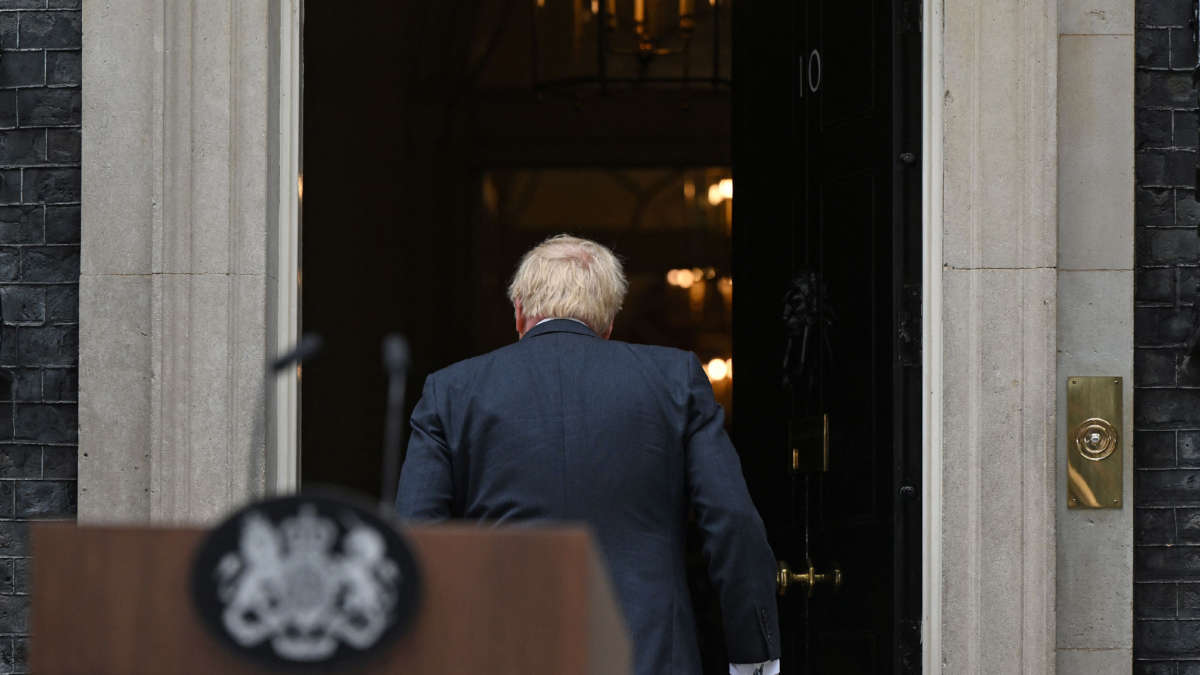

Boris Johnson, U.K. prime Minister, was still present when I began this column in London on Wednesday night. By 9:15 Thursday morning local time, after an extraordinary 36 hours in which dozens of his ministers and Conservative Party officials had resigned, he’d bowed to the inevitable and announced that he would resign, though he tried to fudge the issue by announcing he would remain in power until the autumn. More likely, however, is that he’ll be forced out of office by his own party within days. A man who has been so high for so long will find it difficult to land.
Johnson’s demise presents a rare opportunity for a political reset in Britain; for a rejection of the demagoguery, the scapegoating, the corruption and ultimately the sheer ineptitude of his years in office; and for new, less deliberately conflictual thinking on post-Brexit Britain’s relationship to the European Union. It will also remove Johnson from the Westminster scene. He has used his manifest talents to such malign effects over the past decade building coalitions in Parliament and among the electorate, based largely on a series of resentments of reality.
Johnson, like Donald Trump has been a wrecking ball for institutions and political norms for many years. After making his name as a sensationalist contrarian journalist/commentator, Johnson was elected mayor of London. He was a defiant politician, defying all the usual political stereotypes. He was conservative, but he claimed to have been an environmentalist. He also loved riding his bike. He was a firm believer in traditionalism and empire, but he also supported LGBTQ rights and abortion rights. His national profile was built during his tenure. He quickly rose up the ranks in the Conservative Party and into Parliament when he became a member of the cabinet.
Always nakedly ambitious, Johnson saw a road to power during the Brexit years by opportunistically siding with the Brexiteers, and then sabotaging Theresa May’s government and her leadership by positioning himself as a hard-liner willing to go to (at least rhetorical) war with Europe in order to “get Brexit done.” It worked; in the summer of 2019, he orchestrated a palace coup against May, then, as the party’s new leader, called a snap general election, which the Conservatives, running on populist, nativist themes, won in a landslide.
Throughout his career, however, he was constantly in scandal.
Again, like Trump, Johnson long defied political gravity, essentially bulldozing his way through the opposition and practicing a take-no-prisoners kind of politics that knocked down institutions deemed to stand in the way of his political and personal vision, as well as individuals who didn’t tow the Johnson line enough.
After months of scandals surrounding lockdown-era booze parties at 10 Downing Street, stories of influence-peddling and concomitant deaths emerged in June. declines in the popularity of Johnson as an individual and of the party that he leadsThe prime minister survived a no-confidence vote by the Conservative Party in his leadership. It was organized through the obscure party governing organisation known as the 1922 Committee. He was still defeated politically by more than 40% of his own MPs, who voted against him. Where most political leaders, faced with an internal rebellion of such a magnitude would have either resigned, or at the very least publicly eaten humble pie, Johnson relentlessly ploughed on, declaring his narrow victory to be definitive, and vowing to implement his “mandate” over the coming years.
This week, however, Johnson’s high-wire act finally came crashing down. An MP is the scandal that cost Johnson his job. Chris PincherThere are a number of allegations against Johnson regarding Pincher’s drunken groping of male parliamentarians at various Conservative Party functions. Johnson promoted Pincher to deputy whip despite knowing about the allegations. When the allegations became public, Johnson denied that he knew of them and rallied his cabinet members to defend him. [Johnson]. When it became clear that he was lying to the public, to Parliament and to his own colleagues in the cabinet, Johnson’s already fragile support quickly began to evaporate.
Over an extraordinary 24-hour period, from Tuesday night through Wednesday evening, nearly 40 ministers, including Johnson’s chancellor, Rishi Sunak, and his health secretary (and former chancellor), Sajid Javid, resigned. Another 14 had called it quits by Thursday morning.
Wednesday afternoon in what must be one of the most horrific scuffles. Parliamentary Question TimesJohnson was repeatedly asked endless questions by members of his own party, and many of these questions were answered in U.K. History. Time and again, MPs called on him to resign, and time and again he refused, shouting at, berating, insulting his colleagues and promising — perhaps more to himself than to anyone else — that he would finish the job he had been elected to do. It was a brilliantly tame, but entertaining performance. As he continued to dig in, the questions grew more angry. “Was there any circumstance that he could imagine in which he would resign?” one of his Conservative colleagues angrily asked. Johnson, almost visibly wincing away, evaded the question.
After Question Time is over, Javid, his longtime friend and colleague, dug in the knife, making a deeply personal appeal to integrity and honor and public service in explaining to the House of Commons why he felt he could no longer stay in Johnson’s cabinet, and publicly appealing to others of good conscience in the cabinet to force Johnson’s hand by resigning en masse.
The plotting, counter-plotting, and machinations continued throughout that afternoon and evening and into Thursday morning. In a matter minutes, the bottom of this story would be revealed. BBC’s television news feed updated the numbers of ministers who had resigned; the number of backbench MPs who were saying they no longer had confidence in Johnson’s leadership; the number of senior cabinet ministers — including his newly appointed chancellor, and his home secretary — who were either publicly or privately telling Johnson he had no choice but to resign.
And still the resignation didn’t come. Instead, Johnson dug in. Over the phone, he fired Michael Gove, one of his top cabinet ministers and an erstwhile loyalist who late Wednesday afternoon had told the prime minister it was time for him to go; Gove was, “Downing Street sources” told the media, a “snake.” The beleaguered prime minister announced once again that he had a mandate and wouldn’t let himself be removed from office, even as, practically by the minute, more of his erstwhile colleagues resigned.
Johnson may not literally have grabbed the steering wheel of his Secret Service-driven car, as Trump reportedly did on January 6; he may not have literally cried out, “I’m the fucking prime minister,” in the way that Trump shrieked, “I’m the fucking president” while trying to convince his driver to drive him to the Capitol where his mob was attempting to stop the peaceful transition of power and lynch Vice President Mike Pence. But for all intents and purposes, Johnson’s undignified actions and his refusal to accept that the political jig was up, were similar. This is a man who believes he is the sun, around which the entire world revolves. And, even though his power derives from the parliamentary system, and, in particular, from the Conservative MPs who make up his parliamentary majority, he seemed to have decided that, come hell or high water, he wouldn’t leave office simply because he no longer had majority support even within his own party.
His stubborn clinging power had already become a constitutional crisis as of Thursday morning. It was completely untenable by the beginning of the business day. Johnson was surrounded by ministers who were leaving, and he didn’t have a functioning government to lead. Johnson finally gave in to the inevitable and announced his intention to leave Downing Street.
Johnson was politically a dead man walking from Tuesday to Thursday morning. Now the dead man has stopped walking. It’s an extraordinary moment in U.K. politics.
Will this tale of corruption, malfeasance and corruption lead to a new era in the U.K. Does the widespread condemnation of Johnson’s ways open the door for a wildly different — even opposite — set of political priorities? It could, but only to an extent. Johnson’s unique confluence between corruption, demagoguery, charisma will no longer hold such sway. But the damage done to his opportunistic ways of governance, the chaos unleashed through a hard Brexit and the distrust that Johnson promoted of democratic institutions will likely scare Britain’s political landscape for years.

