
“Do you have a dog?” “Who’s your boyfriend?” “Are you married?”
Anita Carson answered students’ questions about her personal life every year that she taught in Polk County Public Schools, Florida. She gave them a brief presentation about her family and friends and asked them to share their stories. But for the first time in 12 years, when school resumes this fall, the bisexual middle school instructor won’t be in a classroom. She resigned in May due to a combination of factors, chief among them Florida’s recent passage of laws, including “Don’t Say Gay” and the Stop WOKE Act, that limit what educators can say about issues such as sexual orientation, gender identity and race.
Carson argues that the laws prevent educators, particularly members of the LGBTQ+ community from being authentic about their lives, covering important subjects and meeting the socioemotional need of students.
“With the very blatant attacks on education and on marginalized communities, I just couldn’t teach anymore,” said Carson, who is now a community organizer for Equality Florida, an LGBTQ+ advocacy group. “I cannot fathom being in a classroom where I cannot support my kids to the fullest of my ability because there are now laws that tell me what I can and cannot do to support my kids; like, that’s heartbreaking.”
Teachers across the country have resigned in large numbers during the pandemic. A February poll by the National Education Association found that 80% of teachers have resigned during the pandemic. 55 percent of teachers plan to exit the professionThe increase in shortfalls was more rapid than expected, up from 37% last August. It is difficult to track or compare shortfalls nationally as states, counties, cities and municipalities may use different methodologies to determine their needs. These include teacher polls and information on the number of students who have completed education degrees.
According to the Florida Education Association there are more than 9,000 openings for school personnel in Florida. Half of them are teacher positions. In Virginia, there are as many as 2,500 teaching vacancies. Illinois has more than 2,000 such vacancies, and Georgia projects that it will need up to 8,000 teachersOver the next few years.
Students of color are more likely to face teacher shortages in schools with low staffing.
While teacher shortages have left no region of the country untouched, Florida is a flashpoint because the state’s education policies, political climate and anti-teacher rhetoric contribute to the crisis.
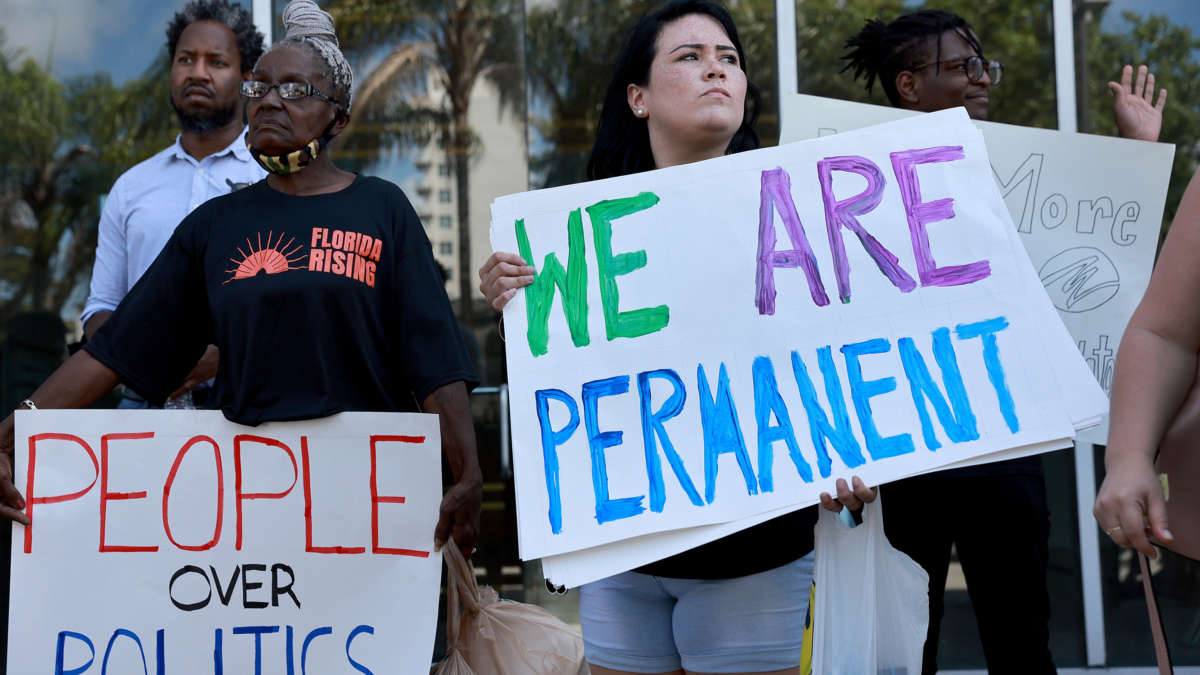
In Florida, about “450,000 kids started school last year without a permanent teacher,” said Norín Dollard, senior policy analyst and KIDS COUNT director at the Florida Policy Institute. “Of course, it’s going to have an effect on academic success.”
Florida educators are being forced to quit due to a unique set od challenges. Along with passing laws that critics claim target the LGBTQ+ community, and people of color in Florida, politicians have called educators threats to students and parents. Teachers in the Sunshine State are quitting in alarming numbers due to what they see as character assassination and low pay. According to the Florida Education Association, Florida had only 1,000 teacher openings in 2010. Today, the organization warns there aren’t enough aspiring educators to fill openings that are at least four times as high. The Florida Department of Education did not specify how many teacher vacancies the state has but disputed that the figure is as high as the teachers’ union reports.
There is a decrease in the number of people entering the profession as a result. In 2010, there were about 8,000 students who graduated from Florida’s colleges and universities with education degrees, said Andrew Spar, president of the Florida Education Association. The association expects that between 2,000 to 3,000 students will earn degrees in this field this year.
“First and foremost, it’s just bad policies that have been passed in Florida that have had a huge impact on people deciding not to come into the profession and people leaving the profession who otherwise intended to stay,” Spar said. “The only thing the pandemic did was accelerate how quickly people left the profession.”
Just a couple of years ago, quitting education had not crossed Carson’s mind. She felt passionate enough about the profession in 2020 to run for a Polk County Public Schools Board seat. She lost the race but she was able to navigate virtual instruction through the COVID-19 crisis’ first year, which she and her colleagues found very stressful. She was grateful to her state’s lawmakers for their appreciation of educators and other essential workers during the pandemic. The rhetoric took a dramatic turn after that. Political groups began portraying teachers as nefarious influences in students’ lives.
“These right-wing extremist groups were talking about teachers indoctrinating kids with liberal [agendas] and saying that teachers are groomers and pedophiles if they ever support LGBTQ-anything in the presence of a minor,” Carson said. “I couldn’t take it anymore. I was like, ‘I have to get out of this. This is toxic. This is not the space that I want to be in anymore.’”
Moms for Liberty is based in the Sunshine State. It was founded by two ex-florida school board members. During the pandemic, their movement to increase parental oversight of curricula relating to race, gender and sexuality spread throughout the country. The group has such influence in conservative circles, Betsy DeVos spoke at the summit Saturday, earning headlines for reportedly calling for an end to the Department of Education, the federal agency she led during former President Donald Trump’s administration.
The so-called parents’ rights movement has led to the introduction of book bansCritical Race Theory bans and curriculum transparency billsIn most states. Florida, however, has gone a step farther with the passage of “Don’t Say Gay” and the Stop WOKE Act. While the former prohibits educators from teaching lessons on sexual orientation or gender identity to children in grades K-3 — which Spar denies ever happened — the latter would allow parents to sue if they suspect that children are learning about critical race theory in class. In addition, last year Florida passed a “Parents’ Bill of Rights” law that prohibits government entities from infringing “upon the fundamental rights of a parent to direct the upbringing, education, health care and mental health of a minor child” without justification.
Carson stated that this legislation could cause LGBTQ+ and other teachers of marginalized groups to hide from students. Straight teachers will likely feel more comfortable answering questions about their personal lives than LGBTQ+ students, she explained. Laws such as “Don’t Say Gay” also lead to confusion because neither teachers nor school districts know exactly how to interpret them, Carson said.
“It was very purposely vague, so that they could continue pushing the concept that it’s not discriminatory,” Carson said, noting that SB 1557 does not actually include the word “gay.” “It doesn’t make it any less discriminatory because everyone knows what they were trying to accomplish, but it does make it a lot harder to implement and makes the job of educators 10 times more frustrating because the districts that we teach in…are trying to avoid lawsuits. So they’re either ignoring it entirely and giving no one guidance, or they are giving incredibly conservative guidance to try and stay away from lawsuits.”
Carson was a scientist, but the Stop WOKE Act made it clear that she wasn’t able to teach science. She was unsure whether she could discuss current affairs with students, which they often bring up, even if her presentation was historically accurate and did not include her personal politics. Carson stated that she made it a point in her classes highlighting the achievements of underrepresented scientists like Wangari Maathai (the late Kenyan environmentalist). Maathai was the first African woman to receive the Nobel Peace Prize in 2004. The Stop WOKE Act indicates that she should not mention Maathai’s race, gender or country of origin, Carson said, even though the information could potentially inspire students.
Spar said laws such as the Stop WOKE Act and “Don’t Day Gay” hurt educators. “Teachers are caring individuals who always want to do the right thing, and it’s very hurtful and very frustrating when you’re trying to do the job you’re hired to do and there’s constant regulation preventing you from doing that,” he said. “And then you have a governor going around the state saying things like, ‘Teachers are teaching kids to be gayTeachers or teachers are teaching sex education in grades 1-3. Teachers are teaching kids to hate White people, or teachers are teaching kids to hate cops,’ all of which is not true at all. It weighs on the profession.”
Although the controversial legislation Florida passed in the last year may have lower teacher morale than other factors, it is not the only reason that educators are leaving the profession. Spar said that the state’s policies on teacher pay and job security have contributed to the educator shortage. In March, Governor Ron DeSantis set aside $800 million in Florida’s budget to raise minimum teacher pay and increase veteran teacher salaries, the third consecutive pay hike he’s approved for teachers. But Florida ranks 48th nationally in teacher pay, with an average salary of $51,009According to the National Education Association, this will be the 2020-21 school year. The recent salary increases have largely benefited newcomers to teaching, while veterans teachers are still paid less than their counterparts elsewhere. Spar attributes this problem. Florida’s Senate Bill 736The 2011 passing of the, which made changes to teacher pay, evaluations, job security, and other aspects.
“The longer you’re teaching, the smaller your pay increases,” Spar said of the legislative change. “A teacher with 10, 15, 20, 30 years of experience today is making less money in Florida than what teachers with that exact same experience made 10 or 15 years ago. I received a call from a teacher. She has been teaching for 25 years, and she’s making $52,000 a year. She found a salary schedule from the 2008-2009 school year in her district, and a teacher with 25 years experience back then was making $59,000 — $7,000 more than she is today.”
Spar said that Florida teachers also no longer have tenure, so they don’t know until the end of each school year if they’ll be invited back for the following year. Dollard, from the Florida Policy Institute, stated that teachers who are geographically close to earning more than educators in neighboring Georgia and Alabama are leaving Florida schools to do this.
Advocates say that the state can retain and attract educators by increasing salaries, providing more security, and changing laws that prevent teachers from doing their best work.
Adam Lane, principal at Haines City High School, Polk County, Florida has come up creative ways to ensure his school has the staff it needs. In 2015, Lane became principal of Haines City High School in Polk County. He started recruiting alums to the school’s staff. Nearly 25% of his 247-member staff are graduates of Haines City High. The school has approximately 3,000 students.
“When seniors graduate, I work with them to be substitutes,” said Lane, who was named the 2022 Florida Principal of the Year by the National Association of Secondary School Principals. “Not only are they making money, they are getting experience as a teacher. In four years, they’re ready to go and they have a job waiting for them back at my school working with me.”
Lane enjoys bringing on former students as teachers because they already know the school’s mission, vision, procedures and staff. Lane noted that the starting salary is approximately $48,000 for the newcomers, but Lane also acknowledged that mid-career teachers may need financial incentives in order to stay in their profession.
Lane is working hard to ensure that his school has a strong teacher pipeline. However, Lane is also making an effort to build relationships with parents at a time in which the two groups are being attacked politically. Haines City High created Parent University with the support of its school guidance counselor. This connects parents with counselors, administrators, and social workers to help them see the job responsibilities.
“There’s a lot of parents out there that want to be better parents, and they want to understand the educational process more, but how are they going to do it if they don’t have an invitation to come to a school?” he said. “The more parents you educate, the less friction or misguided information you’re gonna have.”
As an organizer for Equality Florida, Carson is now educating people about Florida’s education policies and their potential ramifications. She was immediately drawn to the job via Facebook.
“I was like, ‘That’s it. That’s what I need to do. That just fits really well as an LGBTQ educator and an advocate for kids,’” she said. “I am…organizing around these crazy moments that are happening in Florida in schools all across the state. Whether it’s [‘Don’t Say Gay’] or the Stop WOKE law, they’re having to come to terms with these laws without a whole lot of guidance…and with the knowledge that these laws are meant to be discriminatory.”

