
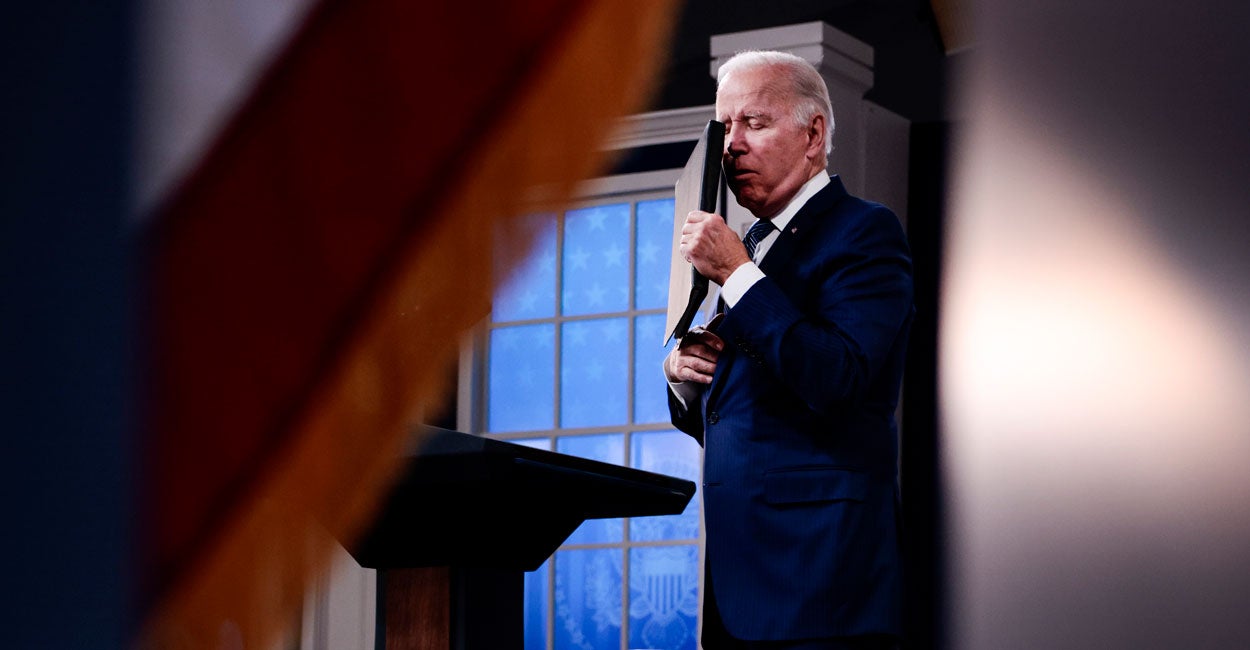
President Joe Biden faces a challenge record-low job approval ratingYou can also find out more about a growing callsFrom within his own party to abandon a campaign for reelection.
Last week, congressional Democrats from Minnesota and New York cast doubt on Biden’s political future, suggesting it was time for a new generation to step forward. Those public statements came on the heels of Gallup’s poll, which put Biden’s job approval rating at a personal low 38%.
History doesn’t bode well for incumbent presidents who face intraparty challenges, according to presidential historian Tevi Troy. His recent Washington Examiner cover story, “Biden faces a mutiny,” examined six examples of 20th-century presidents who faced intraparty challengers—all losers.
Troy, director of the Presidential Leadership Initiative at the Bipartisan Policy Center and a former senior White House aide, joins “The Daily Signal Podcast” to talk about Biden’s future, frustrations plaguing his White House, and interesting tidbits about presidential history.
Listen to the podcast below, or read the lightly edited transcript.
Rob Bluey: I am fascinated by your work as a presidential historian. You have two articles that I am interested in, one from The Wall Street Journal and one from the Washington Examiner. They cover topics that are on the minds of a lot of Americans right now, particularly as we look at the White House and President Joe Biden’s leadership. There are some big questions about his future.
For The Wall Street Journal, you wrote a piece called “Biden’s Dithering Irks White House Staff,” and I’d like you to walk us through what some of the issues are there—why there’s this frustration, and how a lack of decision-making has impeded some of the administration’s agenda.
Tevi Troy And let’s just say, as conservatives, maybe it’s not the worst thing if he’s indecisive, but as Americans, we want a president who can make good decisions for the country, even if we might disagree with where he is going politically.
There have been news media articles. This is again mainstream media complaining about White House decisions. Some of these, such as student loans or something on climate change, have been sitting around for an entire calendar year. Staff are concerned that these things continue to go on, and that Biden is known for asking hard, challenging questions and factual questions.
And then if a staffer says, “Well, I don’t know the answer to that, sir.” They say, “Well, let’s go back and get the answers before we make the decision.” And it becomes an excuse for not making decisions.
And I put out in The Wall Street Journal piece this famous rule from Colin Powell that you can’t make a decision before you have 40% of the information. But if you’re waiting until you have more than 70% of the information, you’re letting the fence define you instead of you defining events.
Bluey: One of the things that I thought was interesting is you take us back to something that Biden himself wrote about his experience of serving as vice president under President Barack Obama. He was critical of Obama’s lack of decision-making at the time. What was that dynamic?
Troy: It’s a good question. The word dithering is a reference to a comment that Dick Cheney, former Vice President, made about Obama’s slowness in making decisions. And Biden in his memoir, which is very complimentary of Obama, as you would imagine, has one minor criticism, is about sometimes decisions wouldn’t get made in a timely manner.
Biden seemed to be saying, “You need to make decisions quickly in the White House,” and then he gets to the White House. … And to be fair, he was more decisive in the earlier months. Perhaps because of the presidency, he seems to have slowed down his decision making process.
Sometimes, you need to think more carefully about these things when the weight of the world is on your shoulders. But at the end of the day, you have to make decisions, that’s what a president does. And so it’s an interesting dynamic that he criticized Obama for not being decisive and now as president, he has some issues with decision-making himself.
Bluey: Do you think his indecisiveness is contributing to the historically low poll numbers that he’s experiencing?
Troy: Actually, I think it’s the historically low poll numbers that make him wonder about his decisions and slow down his ability to choose because he wonders about what the implications will be for him politically. So I wonder if it’s the poll numbers that drive the indecision rather the other way around.
In fact, I stated in the Journal article that he made a few early decisions regarding Afghanistan that didn’t go as well. And so now maybe he’s being a little more careful in his decisions, but you just can’t overdo it.
Bluey: I want to get into the future of Biden’s tenure in the White House. But before I do so, I’d like you to put on your presidential historian hat. You’ve written several books about past presidents. Which presidents were the most successful in making decisions?
Troy: In this Wall Street Journal piece, I intentionally point to Democrats who were good at making decisions because I thought it would be more likely that Biden would listen to advice if it’s coming from previous Democrats.
Franklin Roosevelt was not only a master at making decision. In fact, his wife told the journalist John Gunther once, “The president doesn’t think he decides,” which I thought was a great encapsulation of FDR’s method.
And then Harry Truman, I argue in the piece, had to make more tough decisions per year of presidency perhaps than any other president, including about dropping the atomic bomb on Japan, which is a weapon he hadn’t even heard of when he was vice president; whether to recognize Israel in the face of disagreements from his advisers; whether to pursue the Berlin airlift, which was fraught with peril and a necessary decision, but a tough one.
Then, what to do with Korea? Whether to defend Korea from North Korean invasion or not. Finally, what to do with MacArthur who was popular but unmanageable as an general. He had to make some tough decisions, but he was willing.
And I argue in the piece that Lyndon Johnson, who had his own decision-making problems with Vietnam, marveled at Truman’s ability to make decisions and then move on, which I think is the essence of decision-making with a great leader.
Bluey: One of the biggest decisions that President Biden will have to make is whether or not to pursue a second term. And as we’ve seen in recent days, there are members of his own party who suggest they need a new generation of leadership to step forward. You have a cover story in the Washington Examiner, “Biden faces a mutiny.”
Please tell us about the decision he must make in this case, and any historical facts you have brought to our attention about what it might look like if he faces an intraparty challenge.
Troy: We’ve seen some Democrats making quiet moves, although in the case of Gavin Newsom, the governor of California, not so quiet moves that seem to suggest that they’re positioning themselves for a run in 2024. I began to examine the history of individuals who have challenged an incumbent president within the party. Six major instances were found since the beginning of the 20th century.
All of those cases, and we could discuss the individual ones, I found that the challenger failed to win the nomination and was not elected president. The challenge or the fact that the challenge showed weakness in the incumbent president resulted in the incumbent president not winning election a second consecutive time. Truman, Johnson and two others resigned and four lost their reelection campaigns.
Bluey: It would be helpful to walk through in some detail, maybe not all of the six, but pick a couple. Let’s start with the most recent in 1992. Let’s find out what happened in the case George H.W. Bush, the incumbent president, was joined by Pat Buchanan.
Troy: I would just say people should get the print edition of the Washington Examiner because it has a terrific chart showing each one of these, who the challenger was, who the incumbent was, and what happened.
This particular case, which is interestingly the last time it occurred, Pat Buchanan challenges George H.W. Bush is portrayed as a Trumpy-type candidate, talking about trade and immigration.
Bush was on the verge of a low after the first Gulf War. His approval rating was in high 80s. But it fell as a result of the recession that was plaguing the country. Buchanan, who uses a lot of hard hitting ads and a lot hard-hitting rhetoric to challenge Bush in the New Hampshire primary, wins 38%, which was quite shocking. Although he didn’t win, it showed that Bush had a weakness within his party. Bush people responded with their own tough-hitting ads.
Buchanan is given a speaking slot at the Republican convention. This speech was well-known and remembered for a long time. Bush loses his reelection bid to Bill Clinton. Bill Clinton uses some of the same arguments against Bush as Buchanan used in his efforts to defeat Bush.
Bluey: And then in 1980, of course, you have Jimmy Carter, who’s the incumbent president, facing a challenge from Sen. Ted Kennedy. It was also a high-stakes drama at the convention. Please describe what happened in that case.
Troy: This one was particularly bad. Ted Kennedy, a left-leaning candidate for Jimmy Carter, is running against him. Carter is plagued by all sorts of problems, including a severe recession and energy crisis, inflation, then the Iran hostage crisis. Kennedy is relentless in his attacks against Carter.
And then even at the convention, once it’s clear that Kennedy has no shot to win, and that Carter will be the nominee, his people continue to press and hold up the convention plan, which is carefully, carefully planned out so that you get the maximum of the primetime TV minutes.
And there’s almost a fist fight on the floor over some of the Kennedy people’s efforts to slow down things. And then later Kennedy himself while on the stage carefully and obviously avoids Carter when Carter is trying to do the raised hand in the air gesture to show unity, and Kennedy pointedly will not do it, and it’s an awkward and embarrassing moment.
Bluey: You also note that many of these intraparty challenges happened between the years of 1968 and 1992. And over the course of the last three decades, there hasn’t been nearly the appetite to do so. Are you optimistic that this will change in 2024
Troy: Yeah. In fact, that’s one of the reasons I wrote this piece for the Examiner. Look, that period of ’68 to ’92, especially the first 12 years, was a period of great tumult, there was economic uncertainty. We weren’t sure where things were going in the Cold War. We’d had a rash of assassinations in the 1960s. America seemed to have lost its grip on its past. I believe that this period of tumult was what caused some of the intraparty difficulties. Now, things did calm down in the country, especially in the period from, let’s say, for the ’90s, for example.
And also, I think this message got absorbed that if you’re going to challenge your incumbent president from the flank of the party, the party is probably going to lose in the next presidential election, and you will be blamed for it. And you probably won’t even win the nomination to begin with. So it’s a very low-reward, high-risk strategy and smart politicians try to avoid it.
So I think that’s why we’ve seen fewer of these intraparty challenges over the last three decades. But I think the combination of Biden’s low approval ratings, the many challenges the country is facing, and the fact that people don’t always remember the lessons of history may make this year ripe for one of those intraparty challenges.
Bluey: It’s also interesting that it’s not just Biden’s approval ratings with independents or Republicans, which obviously are low, but Democrats themselves are lower than, say, in comparison to where George W. Bush was heading into 2004 or where Donald Trump was heading into 2020. What do you think about this phenomenon? Biden isn’t the first incumbent president to have won a lot of support from their party.
Troy: These days when presidents seem to be going for the 50.1% strategy, meaning shore up your base and get enough of the middle to get over the top, you really need to keep your party’s base. A large number of Democrats, including a majority, are not interested in Biden running again. This is alarming.
Now, that doesn’t mean that he wouldn’t get the majority of Democratic support if he did become the nominee, but it does indicate that there’s some weakness in the base.
Bluey: I’d like to ask about some of the previous work you’ve done. Your most recent book is “Fight House: Rivalries in the White House from Truman to Trump.” Is this White House as tumultuous as the Trump White House was? Are we just not hearing about it or is it a well-oiled machine that does not necessarily have the types of rivalries you’ve studied in the past?
Troy: It is true that it is a less tumultuous White House than the Trump White House, but that’s kind of a low bar. We also, we don’t hear about it quite as much because I think the media kind of reveled in reporting every infight and every disagreement within the Trump White House.
I think the Biden team has a plan to control information and flow of decisions and keep it within a very small group. This helps reduce infighting in cases. But it also sometimes leads to a bubble mentality where you’re not getting outside information.
And then the other thing I would say is that there’s clearly tumult within the Vice President [Kamala]Harris staff, both within her own staff and with her as well as the rest of her team. So it’s not like this White House is completely devoid of infighting, but there is probably less of it than, and we’re hearing about it last.
Bluey: One of the interesting things that happened recently was that White House communications director Kate Bedingfield announced that she was leaving and then at the 11th hour decided to stay, which is something that’s quite rare in our day and age. Any insight as to what might have happened there and what that might signal for Biden’s presidency?
Troy: I thought that story was fascinating and I did look into it. It is incredibly rare that you have someone announce that they’re leaving and then stay on.
I think there’s a combination of factors. One, from her perspective, you don’t get that many chances to be at this senior level in the White House, and you don’t give it up lightly. So maybe she was having some buyer’s remorse about moving on. And then I think that the Biden administration didn’t necessarily want to lose a prominent woman in a spot as valued as the communications director.
And so I think there are a couple of factors leading to her kind of change decision, but I completely agree with you that you don’t see this happen often.
In fact, more likely is, there was this situation in the Obama White House, I love this story where Christina Romer, who was the chairman of the economic advisers, kind of expressed some concerns about maybe she wasn’t happy in her job, maybe people weren’t listening to her.
The Obama communications team had already prepared the press release that announced her departure within one day. She probably wanted to be reassured that things were going well, but instead she was ushered out of the building.
So I think once you start to signal you’re heading out the door, I think there’s often an effort to push you the rest of the way.
Bluey: Very interesting, indeed. You’ve also studied popular culture in the White House. You have a previous book, “What Jefferson Read, Ike Watched, and Obama Tweeted: 200 Years of Popular Culture in the White House.” Do you have any sense of how this particular White House views popular culture, and maybe how it has shaped President Biden’s opinions on certain issues?
Troy: I just find presidents fascinating. I’ve loved them since I was a kid. I earned a Ph.D. on presidential history and now have the privilege and honor of working in the White House for the rest of my life. I enjoy sharing these wonderful stories about the White House.
Each of my books, which I appreciate you mentioning, tries to find a unique aspect of White House life and then dive into it. So that’s why I did the pop culture thing. That’s why I did the infighting. I also did a book on disasters and how presidents have handled them and then one on intellectuals who’ve served in the White House.
And then in terms of pop culture, look, the White House, when it’s a Democratic White House, obviously gets a big boost from Democratic entertainers. But it’s really hard to see what Biden’s interests are in terms of pop culture. I’ve looked into this issue. He seems to enjoy Irish poetry, I suppose.
I don’t really have a good sense of what songs he likes or certainly not popular songs. Movies, he’s kind of quiet about it. It’s a little strange how little we know about Biden’s pop culture interests.
Bluey: Particularly for somebody who spent so much of his life in the public spotlight, being elected as a U.S. senator at the age of 29, it is truly fascinating that it’s not discussed or talked about nearly as much as previous presidents.
Tevi, as we wrap-up here, I’d like you to tell our listeners about the Presidential Leadership Initiative that you direct at the Bipartisan Policy Center, and some of the work that you do there.
Troy: I do this, as you know, I’m a conservative, I’ve worked for Republican administrations, but I’m interested in this issue of presidential leadership. And I thought that the Bipartisan Policy Centre would allow me to talk to both sides and across the spectrum about the important issue of the presidency and maintaining the power, majesty, and legitimacy of the presidency as one of our few institutions.
Now, you talk about pop culture, Rob, and we’re now in this world of narrowcasting where there’s no one show that everybody watches, there’s no one type of music that everybody listens to, but everybody knows who the president is.
And I believe the president can be a beacon of freedom and help pushing against authoritarianism on either the right or left. The president is a beacon for people all over the world who view America as a place that promotes libertarian values.
I believe that the presidency is the best institution to promote American democracy, freedom, and I am committed to preserving those things. So that’s what I write about from that perch.
And I’ve written a number of pieces, including the one you mentioned in The Wall Street Journal, on presidential leadership. Leadership, I believe, is an important thing to study when it involves the president. I also think it has application in many other fields, such as business and the non-profit world. I believe many people can learn leadership lessons by looking at what has happened at 1600 Pennsylvania Avenue.
Bluey: I can’t let you go without asking a baseball question. Both you and me are huge baseball fans. I am a long-strugggling Pittsburgh Pirates fan. But, we just had the seismic trade deadline in which Juan Soto traded with the Washington Nationals to the San Diego Padres. This is really setting up for a strong pennant run. This year, the playoffs are expanded. Are there any predictions for what we might see as we get down to the final stretch of the baseball season’s home stretch?
Troy: Yeah. I believe the Padres have a very dangerous lineup heading into October. I think it’s a little top-heavy. I don’t know where they go after four and five in the lineup, but that first couple of people in it. Remember that Josh Bell was also acquired from the Nationals. There’s a bit of a Murderers’ Row in the first half of the lineup. I think the Yankees made some slight improvements. They made minor improvements, I believe.
I think the Dodgers have been on such a tear they didn’t feel like they needed to do much at all. And I’m just not sure about the Astros. They’re obviously a very good team, but bringing in a new catcher at this point I’m not sure was the best move with Christian Vazquez. But I think it’s set up for a real interesting October.
I just think the way that baseball is set up, but you’ve got some real super teams, and then you’ve got a lot of teams on the outside looking in, makes for a strange October. But there’s definitely three or four teams to watch, including now the Padres, but also the Dodgers, Astros, Yankees, and Mets I think would be the five teams to look at.
Bluey: It’s certainly going to make for an exciting fall. And you wrote an excellent piece at the start of the season, “Welcome to Baseball’s Gold Age.”
Tevi Troy, thank you so much for being with “The Daily Signal Podcast.”
Troy: Thanks so much. The show is always a joy to watch.
Do you have a comment about this article? To sound off, please email letters@DailySignal.com and we’ll consider publishing your edited remarks in our regular “We Hear You” feature. Please include the URL of the article or headline, as well as your name and hometown.

