
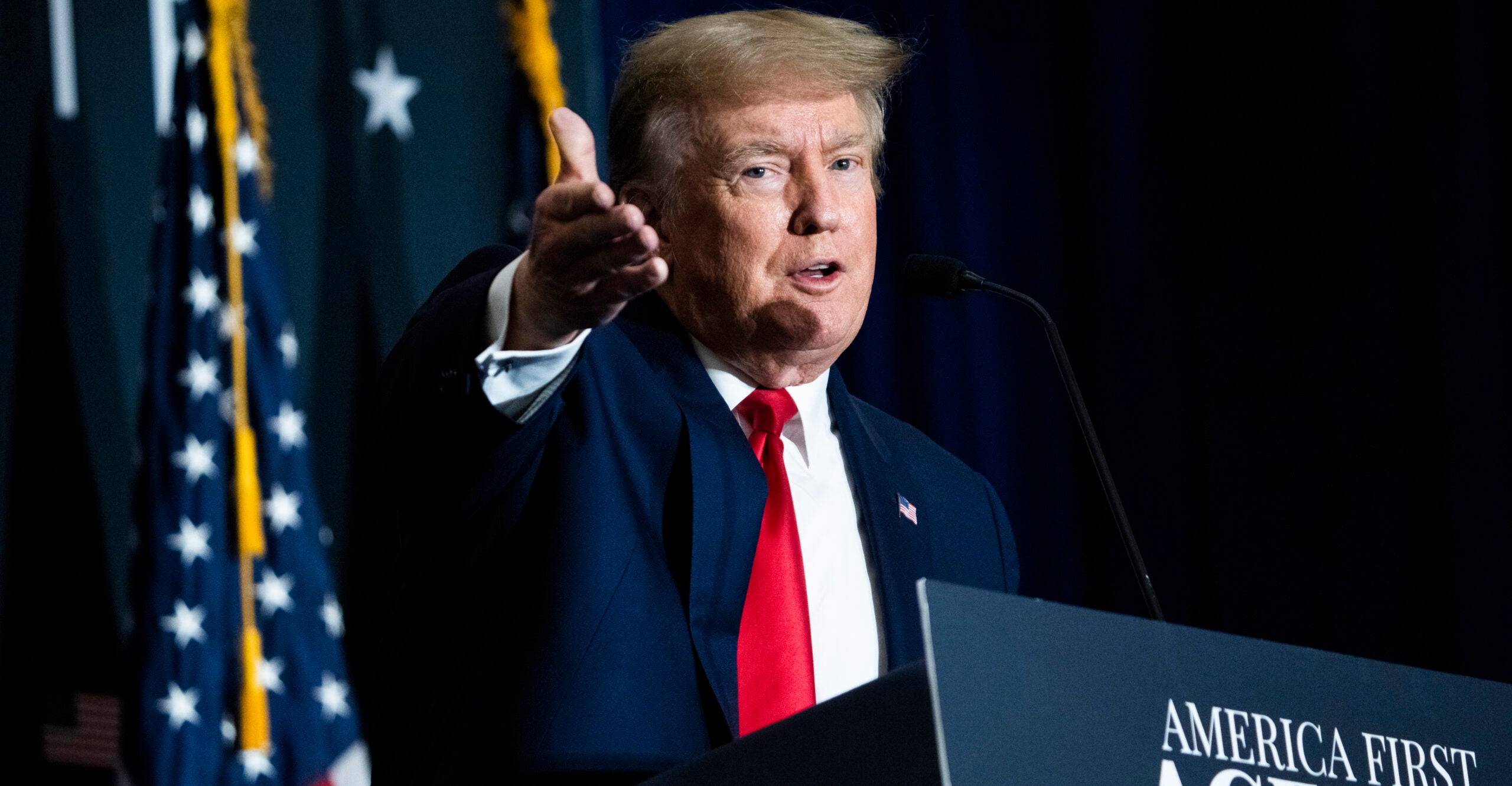
Trump, the former President, focused mainly on fighting crime and keeping Americans secure. However, he veered into other topics Tuesday in remarks jam-packed with policy proposals that lasted more than 90 minutes.
“We need an all-out effort to defeat violent crime in America and strongly defeat it and be tough and be nasty and be mean if we have to,” Trump said in a late afternoon speech that saw him return to Washington for the first time since his last day as president.
The 45th president spoke at America First Agenda Summit at the Marriott Marquis Hotel sponsored by America First Policy Institute. This think tank was founded by former Trump administration officials and campaign officials. The White House is less than 4,000 feet away from the hotel.
Here are seven key takeaways that Trump delivered during his speech. Trump is known for departing from his written remarks quite often.
1. ‘Execute a Drug Dealer … Save 500 Lives’
Trump stated that major drug traffickers were responsible for approximately 500 deaths per year and should be executed for their crimes.
“If you look at countries throughout the world, the ones that don’t have a drug problem are those that institute a very quick trial and death-penalty sentence for drug dealers,” Trump told the crowd.
“It doesn’t take 15 years in court. It goes quickly,” Trump said. “You execute a drug dealer and you save 500 lives because they kill on average 500 people.”
Trump cited Singapore as an example of a country with no drug problem where drug dealers are put to their death.
“It’s terrible to say, but you take a look at every country in this world that doesn’t have a problem with drugs, [and] they have a very strong death penalty for people who sell drugs,” Trump said.
Predicting that the death sentence would be a deterrent to major drug dealers, Trump said: “If we had that, in one year deaths would go down 50%—5-0.”
2. Federal Law Enforcement – Empower
Trump referenced the sometimes fatal riots in summer 2020. He said that governors, mayors, and the federal government did not enforce the law.
“If radical politicians at the state and local levels refuse to protect public safety and instead turn criminals on the loose to prey on the innocent, then the federal government will have no choice but to step in, not wait for the governors anymore,” Trump said.
“I was mandated: ‘Wait for the governors.’ Sometimes I didn’t do that. I was watching too many things happen,” he said, recalling the riots following the murder of George Floyd, a black man, by a white Minneapolis police officer. “In Minneapolis, Minnesota, if we didn’t send in the National Guard, they wouldn’t have a city left.”
Trump added:
We are not going to let the problems we face get in the way of our solutions. We are going to pass legislation to go in and help those people under siege and have governors that don’t know what they are doing. In these circumstances, the federal government is free to do whatever they want.
If we have a weak, foolish or stupid governor, it is our duty to use every power, authority, and constitutional power available to defend our citizens. We must be able enter and clean. [it] out quickly.
3. ‘Most Persecuted Person’ in U.S. History
Trump claimed that the ongoing investigation into the Capitol riot by a majority Democrat House committee was an extension of his previous attacks.
“A friend of mine said recently that I was the most persecuted person in the history of our country,” Trump said. “I said he may very well be right.”
Trump talked about the lengthy Russia investigation, after which special counsel Robert Mueller found no evidence of collusion between the Russian government and Trump’s 2016 campaign.
He also talked about his first impeachment by the House, the one over his phone call with Ukraine’s president.
“Now we have the Jan. 6 ‘un-select’ committee of political hacks and thugs. These are the same people we’ve been dealing with for four years,” Trump said of his term in the White House.
Trump mocked Rep. Adam Schiff of California. Schiff has been involved in every major House probe of Trump and is one the only two Republicans on the nine member select committee investigating the events Jan. 6, 2021.
He also took a swipe at Rep. Liz Cheney of Wyoming, who is vice chairman of the Jan. 6 committee, in dismissing the panel’s seven Democrats as his past political opponents.
“We have the same people [who have investigated before], other than Cheney who is the worst, and crying Adam Kinzinger,” Trump said.
Trump contrasted the lack of prosecutions after the summer 2020 riots organized largely by Black Lives Matter and Antifa activists, with the heavy-handed prosecutions of accused Jan. 6 rioters, including some people who were only on the Capitol grounds and didn’t enter the building.
“It’s so unfair when you see what happened to BLM, when you see what happened to Antifa, when you see what happened [in] all of the killings that took place all over the country,” Trump said. “Then you see what they are doing to people that in some cases didn’t enter the building and are being tortured and handled so horribly.”
“What a sad thing. Something has got to happen, because people are not going to take it much longer,” Trump added. “There’s two sets of justice.”
He spoke out about his future political plans amid widespread expectations that he would run for the presidency in 2024.
“Everything this corrupt establishment is doing to me is about preserving [their] power and control over the American people,” Trump said. “They really want to damage me so I can no longer go back to working for you. I don’t think that is going to happen.”
4. ‘High-Quality Tents’ for Homeless
Trump focused at some length on the country’s growing homelessness problem, particularly in the nation’s capital.
“No civilized society turns over its public spaces to be dominated by drug addicts and the homeless no matter what the reason may be,” Trump said. “If liberals think it’s somehow compassionate, let them invite the homeless to camp in their backyards, soil their property, attack their family, and use drugs where their children are trying to play.”
Saying it was different when he was president, he made some unexpected assertions.
“I fought very hard and very successfully stopping tents from being built [on] D.C. public property,” Trump said, adding:
Every time I [was driven] through the streets of our beautiful D.C. with beautiful monuments—everything is so beautiful—then I would see a cluster of tents. I would immediately send people out. The Secret Service did a fantastic job. I would immediately send people out to remove those tents.
Trump presented a large-scale plan to address homelessness within major cities.
“The only way you are going to remove the hundreds of thousands of people—and maybe throughout the nation millions of people—and make our cities clean, safe, and beautiful again is open up large parcels of inexpensive land in the outreaches of the cities,” Trump said, adding:
Medical professionals can be brought in, such as doctors, psychiatrists and psychologists, as well as drug rehab specialists. Build permanent bathrooms and other facilities–make them good, make them hard, but build them fast. You can make thousands or even thousands of high-quality tents in a matter of hours.
You must move people. Some people say that’s so horrible. No. What’s horrible is what’s happening now, because now they are in tents that hardly function. …
These people, like us, will strive to get their lives back on track. They will leave the tent city to return to the mainstream of society. That is where they want. It’s a great thing.
5. ‘Listen to Fauci … Did the Opposite’
Trump briefly spoke about the COVID-19 pandemic which began to undermine his presidency in 2020 and the disagreements that he had with Dr. Anthony Fauci (long-time director of National Institute of Allergy and Infectious Diseases).
“They said, ‘There is a terrible thing happening in China. There are a lot of dead people laying all over the streets,’” Trump recalled of first hearing early that year about the new coronavirus that causes COVID-19.
He remembered how he moved very quickly to end travel from China into the United States.
“Shortly after that, I closed it up long before Nancy Pelosi wanted it, or any of these people, including Fauci,” Trump said.
“I used to listen to Fauci and whatever he said, I did the opposite,” the former president quipped. “We closed it up and then we had to close [travel] to Europe or we would have had a much worse situation.”
6. ‘Open Borders Are a Gaping Wound’
To secure the United States, Trump told his audience, the nation’s borders must be secured. Biden had shut down all border security measures, including the construction of a wall.
“Our open borders are a gaping wound allowing drugs, gangs, child traffickers, human smugglers, and tens of thousands of dangerous criminals to pour into our country. That’s every week when you hear tens of thousands [unlawfully crossing the border],” Trump said.
Trump rejected the Biden administration’s repeated claims that the nation’s southern border is secure, saying:
We don’t know who is coming in but we do know. [other countries]Their jails are being empty. Last week, 141 people came illegally into our country from different countries. We don’t know who they are or where they’re from. We don’t know anything about them.
Many of these people will cause problems for this country that you don’t know about. [including]Terrorists sending people into the country that will cause us trouble for decades.
7. ‘Fire Rogue Bureaucrats’
Trump asked Congress to pass historic civil service reforms so that non-performing federal bureaucrats can be fired quickly and not take years.
“To drain the swamp and root out deep state bureaucrats, we need to make it much easier to fire rogue bureaucrats who are deliberately undermining democracy, or at a minimum just want to keep their jobs, want to hold onto their jobs,” Trump said, adding:
Congress should pass historic reforms empowering the president … to ensure that any bureaucrat who is corrupt, incompetent, or unnecessary for the job–you ever heard this–’You’re fired. Get out. You’re fired.’ You’ve got to do it. Washington would be a totally different place.
Trump said the appeals process in any attempt to fire a federal employee who isn’t a political appointee has three stages, and each stage takes about five years to complete.
“To fire someone who is doing a bad job, if the government wins, will take 15 years under our current system,” he said.
Do you have a comment about this article? To sound off, please email letters@DailySignal.com and we’ll consider publishing your edited remarks in our regular “We Hear You” feature. Include the article’s URL or headline, along with your name and the address of your town or state.

