
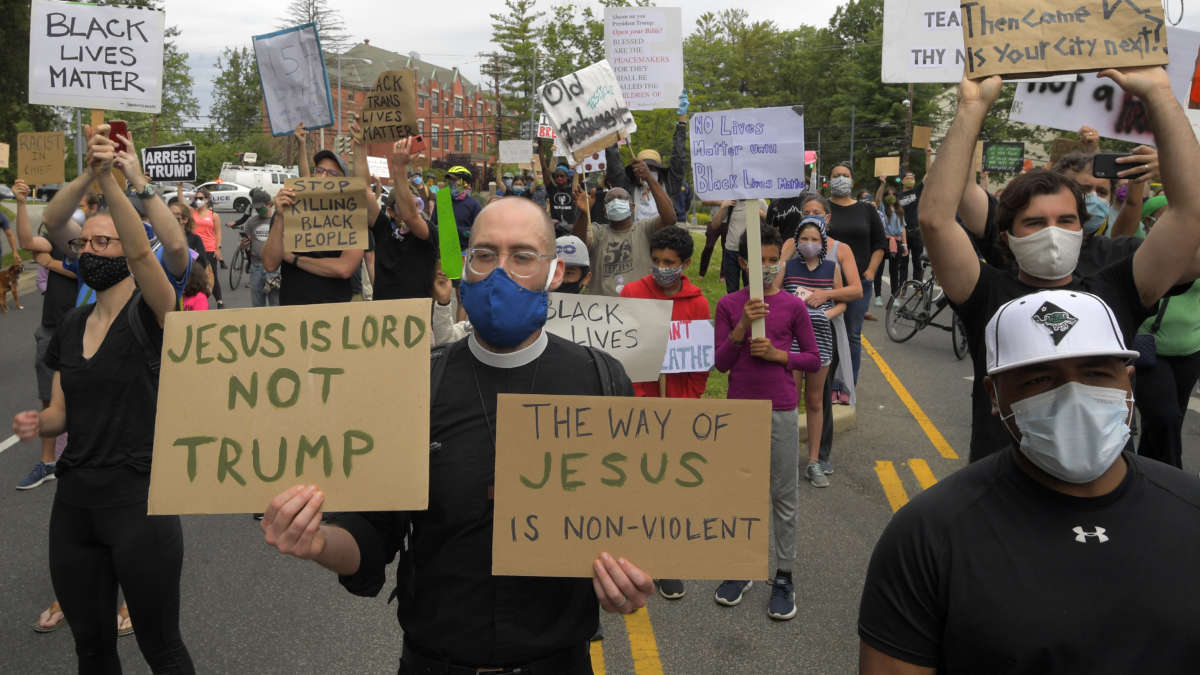
An unanticipated group of Americans are experiencing a potentially historic political shift: evangelical Christians. In the wake of Donald Trump’s presidency, strains within the evangelical community, especially among people of color, have resulted in significant numbers of people defecting from the right and opening themselves to social justice stances on issues of race, immigration, climate and economic fairness. The trend could become a major issue in American politics and extend beyond the religious community.
While the future direction of evangelical politics is uncertain at this point, the divisions in religious spaces are offering significant opportunities to those who want progressive change. Moreover, organizing among evangelical dissenters is providing important lessons in how those working on social justice issues might find fertile ground in communities outside their circles of usual suspects — provided they can relate with people who do not identify as belonging on either side of the traditional divide between the political right and left.
Due to the various ways in which the term “evangelical” is defined, it is difficult to put an exact percentage on the number of evangelical Christians in America today. 2016 surveyWheaton College, a private religious college, estimates that between 90 and 100 million Americans are evangelical. Today, it is generally taken for granted that this constituency is one of the most rock-solid pillars of the Republican coalition — and there is good reason to see things this way: In 2016, 80 percentTwo-thirds of white evangelicals supported Donald Trump, while two-thirds of self identified evangelicals did not support him. sayingTheir faith influences their political beliefs.
However, far-right identification has not been a permanent fixture. In the 1970s, evangelicals were largely considered an apolitical group. To the extent they formed a voting bloc, they were considered divided and persuadable — a constituency that could be won over by Democratic politicians such as Jimmy Carter. Carter was a born-again Christian. Newsweek magazine dubbed 1976, the year of his election, the “Year of the Evangelical.”
A concerted campaignConservative groups like the Moral Majority and the Christian Coalition made sure that any future mentions of evangelicals in politics wouldn’t refer to Democratic presidential victories. In social movement terms, the decades-long project by the “New Right” to transform the evangelical community from a muddled and sometimes apathetic bloc into one of the most die-hard conservative demographics represents an unprecedented organizing accomplishment.
While conservatives are a classic example of how a constituency is polarized in order strengthen allegiances and move indecisive middle-class voters into a political party, the resulting polarization under Trump has caused a backlash. Trump was a master at energizing religious conservators and solidifying their affiliation with him. Analysis from the Pew Research Center suggests even some non-churchgoing white conservatives are now adopting the “evangelical” label — not to show religious identity, but to express a political orientation and demonstrate support for the party of Trump.
However, polarization has the predictable result that even though many people become more passionately partisans, others will begin to feel alienated. You may attract many people to your side by forcing them to pick sides. However, you run the risk of losing some who are not ready to move on. Signs of such a backlash can currently be seen among evangelicals — particularly people of color.
There is no argument that the right has lost control of the evangelicals as a whole. White evangelicals remain the most powerful. fervent supportersFormer President Trump. At the same time, the reaction of evangelical leaders to mass protests around racial injustice, COVID, and #MeToo — along with sexual impropriety and scandals in many churches — have started driving people away in significant numbers. In some cases, those who are leaving are now looking for new expressions of their faith that are aligned with social justice — expressions that sometimes put them squarely at odds with white evangelical Trump supporters.
Even if a small number of evangelicals choose to adopt more progressive stances than others, the impact on the electorate can be huge. For this reason, understanding the divisions that are forming — and analyzing the opportunities they present — is a pressing task.
A Splintering Evangelical Coalition
Recent news stories have highlighted the fact that the evangelical community’s ardent right-wing identification has been causing an increase in the number of defectors. This has been reported primarily in terms of people leaving churches.
Since the 1960s, the percentage Americans who identify as Christians (which used to be well over 90% of the population) has been steadily falling. acceleratingover the past 10 years. The drop-off in white evangelicals has been especially noticeable. According to the Public Religion Research Institute, “23 percent of Americans were white evangelical Protestants in 2006; by 2020, that number had decreased to just 14.5 percent.” Some part of this trend can be attributed to a general waning of public religiosity, as an increasing portion of the population checks “none” on surveys when asked about religious affiliation.
But it would be wrong to underestimate the connection between evangelicals’ diminished share of the population and disaffection with the conservative extremism that pervades many congregations. Following Trump’s election in 2016, the #Exvangelical hashtag became increasingly popularAs many as 50 percent of white evangelicals left their churches, they cited Trumpism among faith leaders as well as their hard-right political platform, as their primary concern.
The exits of prominent members of the movement have highlighted this exodus from evangelicalism. Peter Wehner was one such figure, a political operative who worked in three Republican administrations. A popular op-ed was published for the New York Times titled “Why I Can No Longer Call Myself an Evangelical Republican,” Wehner wrote about no longer feeling comfortable with the designation “evangelical” after witnessing continued support among fellow conservative Christians for Roy Moore, a former Alabama Supreme Court Justice and Republican nominee in a 2017 U.S. Senate race who was accused of sexual misconduct by nine women.
In a similar fashion, Beth Moore, a Bible teacher and conservative Christian (no relation) to Roy Moore. leftSouthern Baptist Convention (or SBC). She cited, among other issues, the failure of her church to condemn Trump’s “Access Hollywood” tape. Institutions such as the Associated Press have been ravaged by the changing political climate. World Magazine, a prominent Christian news organisation, which lost Martin Olasky, editor-in chief several Journalists protesting that the publication was becoming less of a respected news source, and more of a conservative opinion outlet.
These developments are indicative that there is a larger splintering in the evangelical church. Many are questioning whether they are ideologically a part of the community they once called home. They are witnessing growing divisions not just over Trump but also over other issues, such as sexuality and #MeToo. High-profile scandalsThese tensions have been exacerbated by the departure of many parishioners. Megachurches SeattleTo IllinoisTo AlabamaAnd beyond have witnessed resignations from well-known pastors after allegations of sexual misconduct or infidelity — and investigations such as the major report on sexual abuse in the SBCThe May 2022 release of documents has documented the widespread mishandling sexual abuse claims.
In a February 2022 Christian magazine article First ThingsEvangelical writer Aaron Renn argued: “Where once there was a culture war between Christianity and secular society, today there is a culture war within evangelicalism itself.” Not only prominent leaders, but rank-and-file pastors are departing in significant numbers. According to a Barna Group poll, 38 percent of pastors are leaving in 2021. saidThey had considered quitting full time ministry. Scott Dudley is a pastor at Bellevue Presbyterian Church. told The AtlanticMany pastors are leaving their churches and choosing to pursue other careers. “They have concluded that their church has become a hostile work environment where at any moment they may be blasted, slandered, and demeaned in disrespectful and angry ways,” Dudley said, “or have organized groups of people within the church demand that they be fired.”
In a widely circulated February 2022 opinion pieceFor the New York TimesDavid Brooks, columnist and author, looked at this tension within evangelicalism. “The turmoil in evangelicalism has not just ruptured relationships; it’s dissolving the structures of many evangelical institutions,” he wrote. “Many families, churches, parachurch organizations and even denominations are coming apart. I asked many evangelical leaders, who are concerned about Trump’s rise, if they feared that their movement would fall apart. Most said it already has.”
Fracturing along Racial Lines
As with any other issue, the issue of race has caused divisions within evangelical communities. In his article, Brooks cited “attitudes about race relations” as one of the primary factors that has driven Christian evangelicals apart. “It’s been at times agonizing and bewildering,” Thabiti Anyabwile, who pastors the largely Black Anacostia River ChurchWashington, D.C. told Brooks. “My entire relationship landscape has been rearranged. I’ve lost 20-year friendships. I’ve had great distance inserted into relationships that were once close and I thought would be close for life. I’ve grieved.”
April 2017 Special Report Religion Dispatches titled “Betrayed at the Polls, Evangelicals of Color at a Crossroads,” reporter Deborah Jian Lee profiledMany women of color left their churches following the Trump election. Alicia Crosby, a Black social injustice advocate, felt betrayed and left her church in order to found the Center for Inclusivity. Crosby has spoken up about numerous podcastsAbout her experience in leaving the evangelical church to find Christian community elsewhere. She will be retiring in 2019. wrote: “In this moment, it’s not enough to ask how Christians can be more justice-minded, it is necessary to ask them to consider how their tradition and lived out faith practices are complicit in creating conditions for harm, regardless of what shapes their personal moral code.”
Chanequa Walk-Barnes, a professor of theology at McAfee School of Theology, Mercer University, Atlanta, was fired from the majority-white church she had served on staff. “People of color [have been] willing to fit themselves into these white evangelical spaces even when it was uncomfortable,” she told Religion Dispatches. But for her and many colleagues, the dissonance became too extreme: “One friend said the [2016] election was the ‘final nail in the coffin of my relationship with the evangelical church,’” Walker-Barnes explained. “I don’t know if I’m doing a full divestment from evangelical spaces, but I’m definitely pulling back.”
Racial tensions do not seem to be new. However, this March 2018 article demonstrates how racial tensions have changed. articleBy New York TimesCampbell Robertson, reporter, highlighted how right-wing polarization has destroyed efforts to create multi-racial churches communities. A 2012 National Congregational Study showed that two-thirds of those attending majority-white churches were worshiping alongside “at least some Black congregants,” an increased level of church integration since 1998.
However, after the 2016 election, when white evangelicals supported Trump “by a larger margin than they had voted for any other presidential candidate,” churches began to resegregate, reversing previous efforts. Speaking about Trump’s open hostility towards people of color and immigrants, Walker-Barnes told Robertson, “[S]omething is profoundly wrong at the heart of the white church.”
“Everything we tried is not working,” added author Michael Emerson. “The election itself was the single most harmful event to the whole movement of reconciliation in at least the past 30 years,” he said. “It’s about to completely break apart.”
Tensions were further heightened by the May 2020 murder of George Floyd and a renewed wave Black Lives Matter protests. Many evangelicals of colour felt that their congregations were not supporting them or reflecting their values at a time when there was national reckoning. Chicago pastor and two prominent Black evangelicals. Charlie Dates and Atlanta’s John OnwucheckwaBoth left the SBC because of concerns about racism within it. For Dates, the “final straw” was when all six SBC seminary presidents issued a statement in November 2020 that rejectedCritical race theory calling it “incompatible with the Baptist Faith and Message” and “not a biblical solution.”
In December 2020 opinion pieceFor Religion News Service, Dates asked: “How did they, who in 2020 still don’t have a single Black denominational entity head, reject once and for all a theory that helps to frame the real race problems we face?” Dates calls for a “new vision and new standard,” one which will not be “led in full by white men” and which “speaks justice courageously to the government and cares gently for the oppressed, marginalized and women.” A little over a year after Dates’ public exit, in February 2022, the SBC appointedTennessee Baptist pastor Willie McLaurin has been appointed interim president/CEO of the SBC Executive Committee. McLaurin, who is the only Black person to take on an Executive Committee role, is McLaurin.
For his part, Onwuchekwa named four reasons for leaving the SBC, including the “destructive nature of a disremembered history” (the SBC failing to address the ways the organization participated in slavery), “racial repair” (the denomination has not denounced racism), “unhealthy partisanship” (allegiance to the Republican Party), and “shallow solutions where they should be putting on scuba gear” (a focus on unity rather than structural solutions to racial injustice). “The SBC liked me,” Onwuchekwa wrote in his public goodbye letter, “but I feel like they’ve failed people like me. I’d rather give myself to serving that overlooked and under-resourced demographic than merely enjoy the perks of being treated as some outlier.”
A Mixed Evangelical Political System
Although there are signs that new political possibilities may emerge within evangelical spaces that have experienced polarization and division, there is no widespread agreement about what form these may take — and how radically they might break with the orthodoxy of the religious right.
Some dissenters, while perhaps falling in the “Never Trump” camp, remain hardline conservatives, simply wanting a more sedate, family-values Republicanism. Rachel Stone, a former evangelical writer and lifelong evangelical, is one example. wrote in response to the David Brooks article, “Mr. Brooks’s alleged ‘dissenters’ depart from evangelical orthodoxy by not bowing to Donald Trump; otherwise, they’re typical evangelical gatekeepers.” As an example, Stone noted that one of the “Never Trumpers” cited by Brooks, Christian professor Karen Swallow Prior, supportsAmong other conservative policies, the legislation restricting abortion is also restrictive. Other evangelicals seek to make their churches less politically, but not necessarily more progressive. They also propose calls for unity to try to smooth out existing tensions.
In June 2021 Michael Graham, who regularly communicates to evangelical pastors across the nation, created a typology in order to explain these changes within evangelicalism. An article titled “The Six Way Fracturing of Evangelicalism,” Graham divided the community into a half dozen distinct groups. He sees three groups (the “Post-Evangelical,” the “Dechurched, but with some Jesus” and “Dechurched and Deconverted”) as having cut ties with the faith. Among those who have remained, he sees three further factions: “Neo-fundamentalist evangelicals” (who have a strictly orthodox worldview), “Mainstream evangelicals” (who may show concern for “the destructive pull of Christian Nationalism” but are “far more concerned by the secular left’s influence”), and finally “Neo-evangelicals” (who are “highly concerned” by the acceptance of Trump and failure to engage on issues of race and sexuality within the evangelical community). Only the last group of these would be truly able to bring about political realignment.
Nevertheless, Graham sees major changes afoot. He questions whether “big tent evangelicalism” will survive, given the highly visible and even “fatal” divides between fundamentalists and neo-evangelicals. He believes new models of churches will emerge — and are already emerging — to offer compromises to those who fall between categories, or who are still deciding where they belong. “We will see a rising tide of justice-minded churches,” he writes, which is likely to draw in those who are turned off by the right and have interest in the social gospel.
Change is also driven by the values and experiences of a younger generation. Mark Labberton is the president of Fuller Seminary. says that some younger members of the church “want to build communities that are smaller, intimate, authentic, which can often fit in a living room. They see faith as being inseparable from community service to the poor and marginalized. There’s a general interest in getting away from all the bitterness that has devoured the elders and just diving back into the Bible.”
Similar to Cylde Haberman reportedIn the New York Times, “A younger cohort of evangelical Protestants is increasingly Black and Latino. Ethnicity aside, they resemble other young Americans in not automatically sharing their elders’ hostility to same-sex marriage, abortion, or gay and transgender rights.” David Bailey, a Black evangelical in Virginia whose own church is “racially and socioeconomically diverse” told David Brooks he sees that “Christians who are millennials and younger have different views on things like LGBTQ issues and are just used to mixing with much more diverse demographics.”
Tim Keller, the founder pastor of Redeemer Presbyterian Church New York City and a prominent evangelical thinker, sees a younger, more progressive evangelicalism with a politics that can’t be easily classified as right or left. “The enormous energy of [evangelical] churches in the global South and East has begun to spill over into the cities of North America, where a new, multiethnic evangelicalism is growing steadily,” he wroteIn a 2017 New Yorker article. “In my view, these churches tend to be much more committed to racial justice and care for the poor than is commonly seen in white Evangelicalism. This is why they could be called liberal. These multicultural churches, on the other hand are avowedly conservative when it comes to issues such as sex outside marriage. They look, to most eyes, like a strange mixture of liberal and conservative viewpoints, although they themselves see a strong inner consistency between these views.”
Mission-Centered Racial Justice
The vehemence of support for Trump’s white nationalism in many evangelical spaces has prompted some Black evangelicals to leave or to find Black churches rather than remaining in majority-white spaces. Others, however, remain steadfast in their churches and advocate for a mission-centered approach. As Deborah Jian Lee wroteFor Religion Dispatches, some are “reframing the evangelical world as a mission field as opposed to a place for spiritual nourishment, creating ethnic safe spaces or staying firmly planted in evangelical community to combat racism from within.”
Ra Mendoza, who works as a national program director at Mission Year, an urban ministry with evangelical roots, is a Mexican-Latinx evangelical who has been working to create “ethnic safe spaces.” Mendoza told Jian Lee that evangelicals in Mission Year looked to her to “call things out” but that “these groups never invited her to create something that actually corrected the problems she called out; they listened to her critique and they thought that was enough.” Despite this, Mendoza stayed at Mission Year, hoping to create what she described to Lee as “new space that doesn’t perpetuate whiteness and sexism and all the stuff that was built into our DNA for the last 20 years.” Mendoza created a Facebook group to mobilize churches to “protect trans and non-binary people of color.”
In December 2018, articleFor the New Yorker titled “Evangelicals of Color Fight Back Against the Religious Right,” Eliza Griswold wrote about the Black evangelicals taking action to affirm social justice in their church communities. Griswold is profiled Lisa Sharon HarperA prominent evangelical activist. Harper was the former mobilizing director for a Christian social justice group called Sojourners. He is also the president of Freedom Road, which trains religious leaders in social activism. Harper organized evangelical leaders to protest police brutality in Ferguson. Harper organized a trip to Brazil for the purpose of uniting against President Jair Bolsanaro, a far-right president. “Sociologically, the principal difference between white and Black evangelicals is that we believe that oppression exists,” Harper stated.
David Brooks is his part. wroteThere are many dissidents working within their churches to heal the divisions created by Trumpism. “Many of these dissenters have put racial justice and reconciliation activities at the center of what needs to be done,” he wrote. “[T]There are reconciliation conferences, trips from Selma to Birmingham, Alabama, and study groups that read Martin Luther King Jr. or Howard Thurman. Evangelicals played important roles in the abolitionist movement; these Christians are trying to connect with that legacy.”
By organizing within marginalized communities, Black evangelicals diametrically oppose Trump’s ethno-nationalistic coalition. Because people of color are the fastest growing segment within evangelicalism’s movement, their organizing has the potential to influence the larger political orientations of the local community. (A 2015 Pew Research studyAccording to some estimates, the majority of Christians will be made up of people of color by 2042. “Evangelicalism has been hijacked byThe religious right,” Harper told the New Yorker. “We come from the arm of the church that is so toxic, we understand it and we can offer a solution.” Her solution is that Black evangelicals propose an alternative rooted deeply in faith and “vehemently jealous for the human dignity of all people.”
Phoenix, Arizona is one example of an organization that uses this missional approach to racial reconciliation and justice. The Arizona group called the Surge NetworkThis is linked to a nation-church renewal movementTim Keller co-founded the organization. It has drastically changed the composition of its leadership team to be dominated by women and people of colour in recent years. It has been a key player in activating its evangelical constituency. It mobilized interfaith responses for George Floyd’s murder and organized religious people to join Black Lives Matter protests.
Surge was able to get 3,000 people out of 200 churches to join his church in one instance. marchThe Arizona Capitol was the destination for the public prayer. Ministers led the procession through downtown Phoenix. Melissa Hubert, a Redemption Church Alhambra deacon, read the names and addresses of those who were killed by police as the crowd knelt. One placard incited to protest was among the many. Hebrews 13:3: “Continue to remember those in prison as if you were together with them in prison, and those who are mistreated as if you yourselves were suffering.” Beyond such public-facing mobilization, Surge leads a religious education program called the “Neighbors Table,” which prompts local parishioners to lean into hard conversations about criminal justice reform, immigration and Islamophobia through discussion and meals with neighbors directly impacted by these issues.
What is the future of evangelical politics? This remains to remain to be seen. But the current juncture has created a moment loaded with potential, in which the unprecedented alignment of evangelicalism with the Republican right is being shaken — at least at the margins — and new possibilities are emerging. While white evangelicals may still be conservative loyalists but the number of people who once were among their parishioners but have since been alienated due to their intolerance could reach the millions.
Those are millions of people that no movement should ignore if it wants to make the world a better place.
Celeste Pepitone Nahas provides research assistance

