
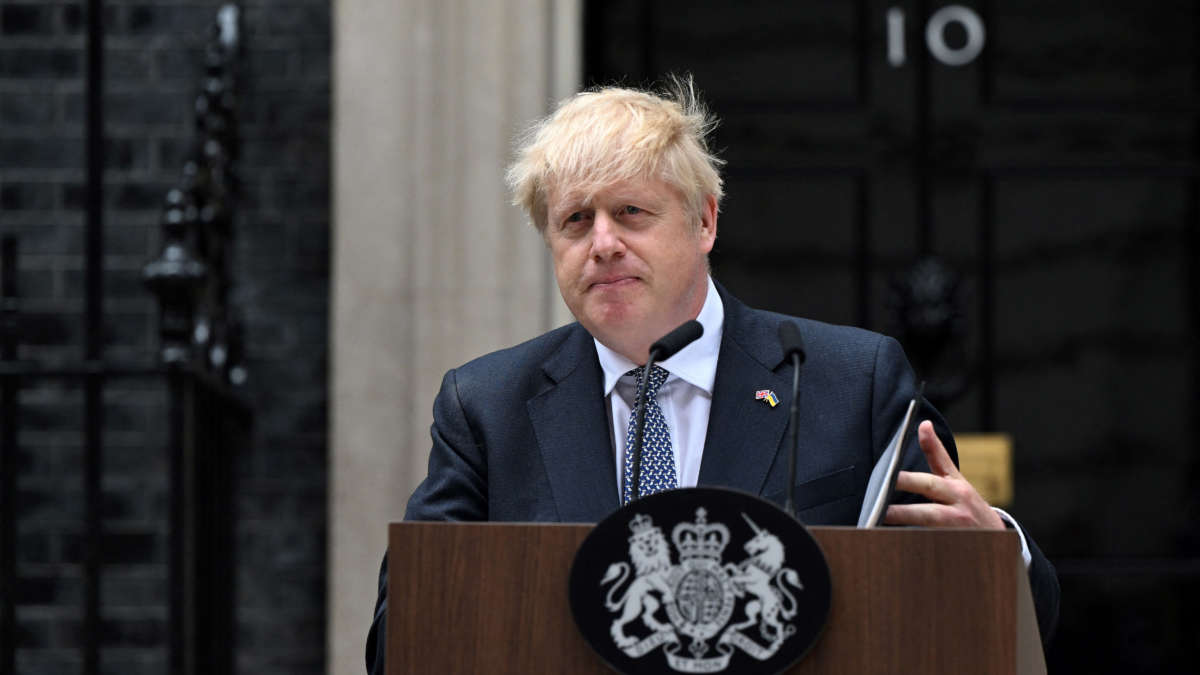

Boris Johnson (the right-wing, embattled Prime Minister of the United Kingdom) announced on Thursday that his resignation would follow dozens of exodus from his cabinet.
Before his announcement outside 10 Downing Street, at least 59 members of Johnson’s administration had left their postsIn response to his appointment earlier this year of a minister who had been accused sexual assault and misconduct on numerous occasionsMost recently, at a party in London last Wednesday.
Johnson’s resignation comes with a caveat: He won’t officially leave his position as prime minister, he said, until a successor is chosen to replace him. This process could take many months as the 1922 Committee, which is a parliamentary group of backbenchers from Johnson’s Conservative Party, can be involved. will likely use the summer recess to decide who it will endorse as his replacement.
Johnson acknowledged that it was time for him to leave his post, as he had lost the trust of his own party’s members.
“It is clearly now the will of the parliamentary Conservative Party that there should be a new leader … and therefore a new prime minister,” he said.
Johnson said that he stayed on as long as possible because he felt it was his “duty” and “obligation” to continue his work. This past week, Johnson claimed that he had a lasting mandateFrom the moment he was appointed prime minister in 2019.
Johnson lamented the resignations of his own party members — “The herd instinct is powerful and when the herd moves, it moves” — but added that he was confident that the “brilliant and Darwinian system will produce another leader.”
Johnson’s stint as prime minister was marred by a series of controversies, including one that has been dubbed “Partygate,” wherein During the COVID-19 pandemic large gatherings were held by members of his government.Despite the public health restrictions for the general population.
Johnson’s latest controversy involves allegations of sexual assault by his former deputy chief whip Chris Pincher, who he promoted to the position earlier this year. Behind the scenes Johnson was briefed about Pincher’s past scandals — which included making improper and unwelcome advances on numerous men — but still went forward with his initial appointment in 2019, as well as his recent promotion.
Pincher was at a party last week where he is being accused by two men that he groped them while he had been drunk. After the accusations were made, he resigned.
In the days after Pincher’s resignation, Johnson waffled on whether he had been aware of Pincher’s past. Tuesday saw details of the briefing Johnson received from a member of his Cabinet about Pincher in 2019. Johnson admitted to it in a Tuesday interview. BBC interview that he indeed knew about his former deputy’s previous sexual misconduct, and that it was a “mistake” to appoint him.
Another cabinet official recently suggested that Johnson was uncaring about Pincher’s past, saying that the prime minister had privately joked about his deputy’s actions by describing him as “Pincher by name, Pincher by nature.” Johnson did not denyThe line in his BBC interview.
This week’s revelations led two high-ranking members of his cabinet — Chancellor of the Exchequer Rishi Sunak and health secretary Sajid Javid — to resign from their government posts in protest. Over the next two days, dozens more officials resigned.
Although Conservative Party members may be relieved Johnson is leaving his post, Labour Party ministers expressed dismay that Johnson would likely remain in office throughout the summer and into fall.
“We are stuck with a government that isn’t functioning,” Labour Party leader MP Keir Starmer said on Twitter. “The Prime Minister needs to go completely — not cling on for a few months.”
“If the Tory party doesn’t get rid of him, Labour will act in the national interest and bring a vote of no confidence,” Starmer added.

